
Romania's National Nuclear Power Company Plans to Borrow EUR 800 Million from the European Investment Bank: Full Speed Ahead on the Refurbishment of Cernavodă NPP Unit 1
 Scan to share
Romania's National Nuclear Power Company (Nuclearelectrica) recently submitted a disclosure to the Bucharest Stock Exchange (BVB), announcing plans to obtain a long-term loan totaling EUR 800 million from the European Investment Bank (BEI), earmarked to finance the Unit 1 Refurbishment and modernization project at the Cernavodă NPP. This major external financing plan has been placed on the agenda and will be formally submitted to shareholders for approval and deliberation at an extraordinary general meeting to be held from October 29 to 30, 2026.
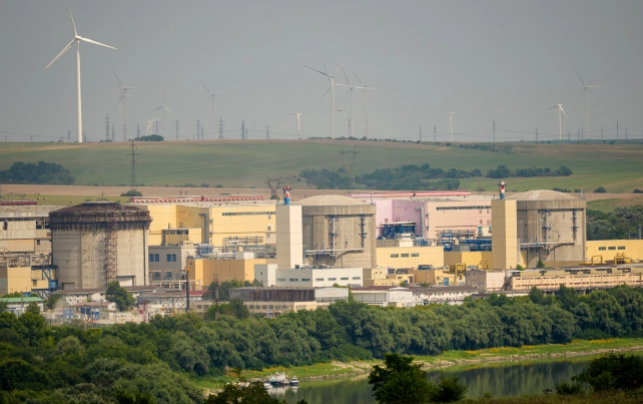
The European Investment Bank's Board of Directors had previously formally approved on July 15, 2026, an EUR 800 million credit facility for the project, which Nuclearelectrica regards as a milestone financial breakthrough of landmark significance for Romania's civilian nuclear industry and even the nation's strategic energy transition. According to the funding implementation plan, this EUR 800 million credit will be split into two separate financing contracts of EUR 400 million each to be signed sequentially——the first is expected to be formally signed within 2026, and the second is expected to fully complete the statutory signing and entry-into-force procedures in early 2027.
The overall refurbishment project of Cernavodă Unit 1 relies on a diversified combined financing structure, encompassing Nuclearelectrica's own capital, loans from international financial institutions, export credit guarantees, and commercial syndicated loans. In the preliminary preparation phase, Nuclearelectrica signed on September 24, 2025, a syndicated loan contract worth EUR 540 million with an international commercial bank consortium led by J.P. Morgan SE, securing ample liquidity support for key upfront works.
At present, the Unit 1 refurbishment project is in the second phase of the strategic plan pending shareholder approval, with key tasks covering nuclear safety and environmental licensing applications, signing of engineering, procurement and construction contracts and construction service agreements, allocation of long-lead advance payments for core equipment and material procurement, and the establishment of a closed-loop full-cycle funding chain. Related site civil preparation and auxiliary facility construction have already been fully underway during 2025-2026.
According to the overall project schedule, the project will enter the third phase—the core on-site critical period—from 2027 to 2030. During this period, Unit 1 will be officially shut down for in-depth technical modifications, including major nuclear reactor overhaul operations such as full-core re-tubing; after all mechanical and electrical equipment refurbishment is completed, system integrated commissioning, comprehensive acceptance, and decommissioning of temporary facilities will be progressively advanced, with the goal of achieving high-standard reconnection of Unit 1 to the grid for power generation in 2030, extending its safe operating life by 30 years.
Since Cernavodă Unit 1 (CANDU heavy water reactor) entered commercial operation in 1996, it has cumulatively delivered over 150 million megawatt-hours (MWh) of clean electricity stably to Romania's power grid, with cumulative CO2 emission reductions of approximately 145 million tonnes. In long-cycle operation and maintenance, this reactor ranks among the global top three with a long-term average capacity factor exceeding 90%, serving as a core strategic pillar for Romania in safeguarding energy independence and grid baseload security.
Disclaimer: Information republished from partner media, institutions or other websites is provided for reference and communication purposes only. It does not imply endorsement of its views or verification of its accuracy. Please contact us if any content infringes rights or requires correction.