
Search Results
Keyword:Fuel Cycle

First batch of experimental stations at Russia's Siberian Circular Photon Source expected to be operational by end of 2026
On August 11, Russian President Vladimir Putin stated at a meeting of the Council for Science and Education that the first research stations of the Siberian Circular Photon Source (SKIF) synchrotron are expected to be commissioned by the end of 2026. At the meeting, Putin noted that the Siberian Circular Photon Source is currently one of the world's most powerful particle accelerators, with some parameters being unique, capable of helping researchers conduct in-depth studies of the structure of matter at the atomic and molecular levels. He also stated that Russia needs to accelerate the development of future technologies, concentrate efforts on priority tasks, and make more efficient use of national strategic scientific resources, including research institutions, advanced digital computing resources, and unique biological resources. The Siberian Circular Photon...
2026-08-12

Belarusian NPP safe operation period may be extended to 100 years, with first spent fuel to be shipped to Russia for reprocessing in 2034
Stanislav Levitsky, head of the Rosatom representative office in Belarus, stated on the "Economic Environment" program of Belarusian TV Channel One that Belarusian nuclear energy development is backed by comprehensive safety assurances. He emphasized that while nuclear facilities can indeed have serious consequences if mismanaged, under the existing risk control system and modern technological support at the Belarusian NPP, nuclear power can become a low-cost, stable, and safe energy source. Levitsky believes that amid intense competition in the energy sector, some irresponsible players may use information tactics to create anxiety and attempt to provoke panic among the public...
2026-08-10

Mutsu City Requests Submission of Revised Plan for 5,000-Ton Transport to Spent Fuel Interim Storage Facility
On August 7, Tomoya Yamamoto, Mayor of Mutsu City, Aomori Prefecture, Japan, met with representatives of Recycle Fuel Storage (RFS) and its co-investors Tokyo Electric Power Company Holdings (TEPCO HD) and Japan Atomic Power Company (JAPC), requesting the three parties to submit a revised mid-to-long-term spent nuclear fuel transport plan, with consideration given to inter-operator cooperation. The plan may involve accepting spent nuclear fuel from other electric power companies. The facility in question, located in Mutsu City, Aomori Prefecture, is currently Japan's only interim spent fuel storage facility situated outside a nuclear power plant site. Under the existing siting agreement, the facility's acceptance scope...
2026-08-08

German team achieves first separation of tritium-containing hydrogen isotope mixtures using silver-exchanged zeolites
A team at the Helmholtz-Zentrum Dresden-Rossendorf (HZDR) and partners recently demonstrated a new method for separating hydrogen isotopes using silver-containing zeolites, successfully separating hydrogen isotope mixtures containing radioactive tritium through a porous solid material for the first time. The research findings were published in Nature Communications. Future fusion power plants will require not only high-temperature plasma and strong magnetic fields during operation, but also a stable fuel cycle system for recovering, separating, and reusing deuterium and tritium. Inside a fusion reactor, deuterium and tritium participate in reactions and release energy, but the fuel is not completely consumed, and the residual gas may also contain ordinary hydrogen (protium), forming a mixture of protium, deuterium, and tritium...
2026-08-07

Seoul National University NEXFO Workshop: Exploring Sustainable Solutions for SMR and MMR
On August 7, the Nuclear Policy Center at Seoul National University's Institute for Future Nuclear Energy Policy announced that it will host the Nuclear Energy Sustainability NEXFO Workshop on the afternoon of September 16 at the Seoul National University Global Engineering Education Center. The event, coinciding with the center's 10th anniversary, is themed "Embracing the Era of Full-Scale SMR and MMR Deployment" and will discuss the policy, industrial, and technological conditions for the commercialization of small modular reactors and micro modular reactors. The workshop will first revisit the public discourse framework on nuclear energy sustainability, and analyze global nuclear fuel cycle trends as well as the domestic challenges facing South Korea. As SMRs and MMRs transition from technology demonstration to practical application, nuclear fuel...
2026-08-07

Curio, NuScale and Framatome Sign MOU to Advance Next-Generation Nuclear Fuel Cycle Solutions
Curio, NuScale Power and Framatome Inc. recently signed a strategic memorandum of understanding to jointly evaluate integrated nuclear fuel solutions aimed at strengthening the U.S. nuclear fuel supply chain and supporting the international nuclear energy market and the deployment of next-generation nuclear technologies. Under the agreement, the three parties will conduct evaluations centered on Curio's proprietary NuCycle recycling technology, focusing on the conversion pathways of recyclable nuclear materials from "source to product" and from "source to fuel." The collaboration also encompasses future engineering coordination, fuel development, fuel qualification, manufacturing and commercialization, as well as advancing the integration of nuclear supply chain-related segments...
2026-08-07
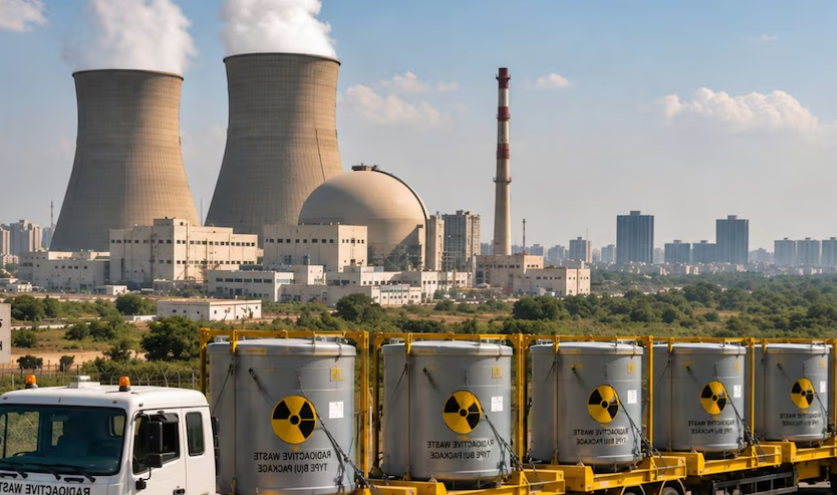
Behind India's Nuclear Power Expansion: Where Does Radioactive Waste Go? Government Details Management Process in Parliament for First Time
India is rapidly advancing its nuclear power expansion, but the safe disposal of radioactive waste is the least-publicized challenge. The government has for the first time detailed in Parliament how it handles hazardous waste. In a written reply, the Department of Atomic Energy disclosed that all nuclear power plants in India generate an average of 0.15 cubic meters (approximately 150 liters) of solid radioactive waste per megawatt (MW) of capacity annually, including waste from operational and decommissioning phases, equivalent to about 1.5 household bathtubs in volume; radioactive waste quantities and disposal records are regularly reported to the Atomic Energy Regulatory Board (AERB). The operation and maintenance of nuclear power plants generate various types of radioactive waste, including spent filter cartridges, protective clothing, tools, equipment, and other items that come into contact with radioactive materials. Waste is categorized into gaseous...
2026-08-03

Utah Finalist for DOE Nuclear Fuel Cycle Site, with Great Salt Lake Rescue as Bargaining Chip
Utah is seeking an agreement with the U.S. Department of Energy (DOE), hoping to secure federal nuclear hub status while also gaining assistance in addressing the Great Salt Lake crisis. Governor Spencer Cox and U.S. Energy Secretary Chris Wright signed a memorandum agreeing to collaborate on realizing the full value of the nuclear fuel cycle. However, this agreement does not mean Utah has decided to build the nuclear hub, and the state will decline if it is deemed unsafe or disadvantageous. Currently, Utah is one of five states competing for the federal Nuclear Lifecycle Innovation Park, which aims to consolidate all aspects of the nuclear fuel cycle in one location, including fuel fabrication, enrichment,...
2026-08-03

Radiation protection expert Peter Bryant to lead University of Liverpool's Chadwick Institute for Nuclear Innovation
The University of Liverpool has announced that Professor Peter Bryant has been appointed as the Director of the newly established Chadwick Institute for Nuclear Innovation, with his tenure officially commencing in September 2026. The Chadwick Institute for Nuclear Innovation is named after Nobel laureate Sir James Chadwick, who served as Head of the Physics Department at the University of Liverpool and is renowned for his discovery of the neutron. The Institute will leverage the University of Liverpool's research expertise, innovative facilities, and strategic partnerships in the nuclear energy sector to advance research and talent development in nuclear innovation. Bryant has long been engaged in work related to the civil nuclear fuel cycle, with his research and management portfolio encompassing radiation protection, environmental permitting, radioactive waste...
2026-08-03

Germany to Establish Fusion Technology Research Center at Karlsruhe Institute of Technology
The German federal government is advancing the layout for the country's first fusion reactor. According to a decision announced on July 29, 2026, by the German Federal Ministry of Research, Technology and Space (BMFTR), one of three newly established fusion research centers will be located at the Karlsruhe Institute of Technology (KIT), focusing on fuel cycles, new materials, and engineering technology research for fusion power plants. In line with Germany's Fusion Action Plan, the new research centers will integrate the efforts of scientific institutions and industry to concentrate on solving key technical challenges before the application of fusion energy. The center at KIT will leverage the institute's expertise in fusion fuel cycles, high-performance materials, and core reactor components to advance related achievements...
2026-07-30

Russian regulator inspects nuclear fuel cycle safety compliance at Ural Electrochemical Plant
On July 27, the Department for Supervision of Nuclear Fuel Cycle Facilities, Ship Nuclear Power Plants and Radiation Hazardous Facilities of the Federal Service for Environmental, Technological and Nuclear Supervision of Russia conducted a routine on-site comprehensive inspection of the Ural Electrochemical Plant Joint-Stock Company located in Novosibirsk, focusing on verifying the enterprise's compliance with relevant federal laws, regulations, and regulatory license terms on the use of atomic energy. The inspection covered multiple aspects of the operational safety of nuclear fuel cycle facilities, including the implementation of responsibilities of the operating organization in safety assurance, maintenance of performance of important safety systems and components, safety control during technical process implementation, compliance with decommissioning requirements for nuclear facilities, and safety of radioactive waste treatment...
2026-07-30

U.S. Department of Energy Selects Five States to Explore Building Nuclear Lifecycle Innovation Hubs
The U.S. Department of Energy (DOE) announced on July 28 that it has selected Utah, Tennessee, Oklahoma, Louisiana, and Idaho as potential host states for Nuclear Lifecycle Innovation Hubs. The DOE has signed memorandums of understanding with these five states and will continue to evaluate the conditions and plans for hosting the hubs in each state. On January 28 of this year, the DOE issued a Request for Information, inviting states to express interest in building Nuclear Lifecycle Innovation Hubs. The proposed hubs are intended to support full lifecycle activities for nuclear fuel, including fuel fabrication, uranium enrichment, spent nuclear fuel reprocessing, and waste disposal. Depending on state priorities and regional capabilities, the hubs may also accommodate...
2026-07-30

Europe Completes Manufacturing of JT-60SA Pellet Centrifuge Accelerator
The European Fusion Energy Organization (F4E) recently announced progress on key components of a new pellet injection system for the upgrade of the JT-60SA device. The centrifuge accelerator, manufactured by Sener, has been completed and delivered to the Max Planck Institute for Plasma Physics (IPP). It will subsequently be integrated with other components of the pellet injection system and undergo testing. The operation of fusion devices relies on the continuous supply of hydrogen isotope fuel. In devices such as JT-60SA and the International Thermonuclear Experimental Reactor (ITER), the pellet injection system is used to fuel the plasma and assist in controlling plasma instabilities. The system typically consists of three parts: preparation...
2026-07-29