
Search Results
Keyword:NSI

KHNP's Comprehensive Nuclear Power Plant Maintenance Qualification System Recognized by South Korean Government
Korea Hydro & Nuclear Power (KHNP) announced on August 7 that its comprehensive nuclear power plant maintenance qualification system has received government recognition from the Human Resources Development Service of Korea, an affiliate of South Korea's Ministry of Employment and Labor. The system is primarily designed for nuclear power plant maintenance positions, aiming to enhance the professional knowledge and on-site technical capabilities of practitioners. Government recognition refers to the formal confirmation by the government of a qualification certification system used within a company to improve employee skills. KHNP believes this signifies that the objectivity and credibility of its qualification assessments have been recognized at the national level, contributing to...
2026-08-07

Dark Energy Survey Releases Six-Year Results: Data from 669 Million Galaxies Helps Constrain Cosmic Accelerated Expansion
On August 4, the Dark Energy Survey (DES) project released its six-year findings on dark energy detection. The project compiled 18 related papers, based on nearly 300,000 astronomical images captured between 2013 and 2019, recording information on 669 million galaxies, thousands of galaxy clusters, and more than 3,000 supernovae to study the accelerated expansion of the universe and the evolution of cosmic structure. To carry out DES, Fermi National Accelerator Laboratory built an extremely sensitive 570-megapixel digital camera, DECam, which was installed on the Blanco 4-meter telescope at the National Science Foundation's Cerro Tololo Inter-American Observatory in the Chilean Andes. (Image courtesy of Reidar Hahn/Fermi National Acceler...
2026-08-06

"China Nuclear Power Development Report (2026)": China's Total Scale of Operating and Approved-Under-Construction Nuclear Power Units Ranks First in the World
On August 6, the National Energy Administration released the "China Nuclear Power Development Report (2026)". As of the end of 2025, China had a total of 112 nuclear power units in operation and approved for construction, with a total installed capacity of 125 million kilowatts, ranking first in the world. Among them, 59 units were in operation with an installed capacity of 62.48 million kilowatts, ranking third globally; 53 units were approved and under construction with a capacity of 62.93 million kilowatts, maintaining the world's largest nuclear power engineering construction scale for 19 consecutive years. The report shows that during the "14th Five-Year Plan" period, China newly approved 46 nuclear power units with a total capacity of 54.5 million kilowatts, and newly commissioned 11 units with a capacity of 12.45 million kilowatts. In 2025, China commissioned one new nuclear power unit, namely Unit 2 of the "Guohe One" demonstration project; and approved the construction of 10 new nuclear power units with a total capacity of 12.1 million kilowatts, involving Units 5 and 6 of Zhejiang Sanmen, Units 5 and 6 of Shandong Haiyang, Units 1 and 2 of Fujian Xiapu, Units 3 and 4 of Guangdong Taishan, and Units 5 and 6 of Guangxi Fangchenggang...
2026-08-06

Department of Plasma Physics and Fusion Engineering at the University of Science and Technology of China Proposes New Three-Dimensional Magnetic Field Configuration for Stellarators
Stellarators confine high-temperature plasma using three-dimensional magnetic fields generated by external coils, enabling steady-state operation without relying on plasma current and avoiding instabilities such as disruptions, making them the fastest-growing technological route globally. However, if the three-dimensional magnetic field is not carefully optimized, trapped particles can experience significant radial drift, leading to a substantial increase in neoclassical transport losses. To suppress this drift, the magnetic field must satisfy the "omnigenity" condition, meaning that the time-averaged radial drift of all trapped particle orbits is zero. The most widely applied class of omnigenous magnetic fields is poloidal omnigenity (PO), and such configurations are also commonly referred to as quasi-isodynamic (QI) configurations...
2026-08-06

South Korea Designates SMR and MMR as National Strategic Technologies; South Gyeongsang Province Says It Will Promote Transition of Nuclear Power Companies
South Gyeongsang Province said on August 4 that it welcomes the South Korean government's designation of Small Modular Reactors (SMR) and Micro Modular Reactors (MMR) as national strategic technologies in the 2026 tax reform plan. Under the relevant arrangement, the South Korean government will revise the Special Tax Treatment Control Act and its enforcement decree to include industries related to small modular reactors of 300 MW or less and micro modular reactors of 20 to 30 MW class within the scope of national strategic technologies. Going forward, companies conducting R&D on SMR and MMR technologies or investing in related facilities will be eligible for higher tax credits for R&D and facility investment. South Gyeongsang Province believes that this policy will provide an opportunity for local nuclear power companies to transition into the SMR...
2026-08-05

South Korea Accelerates Safety Reviews of Long-Term Operating Nuclear Reactors and Advances Licensing of First Spent Fuel Dry Storage Facility
The Nuclear Safety and Security Commission (NSSC) of South Korea stated at its second-half work report meeting on August 4 that it will accelerate safety reviews of long-term operating nuclear reactors while simultaneously advancing regulatory efforts such as licensing systems for spent fuel dry storage facilities and small modular reactors. Under the plan, the NSSC will conduct safety inspections on nine reactors applying for continued operation, with review standards referencing newly built nuclear power plants and confirming safety margins in consideration of the characteristics of long-term unit operation. Among these, whether Kori Nuclear Power Plant Units 3 and 4 will be approved for continued operation in the second half of this year, and whether Hanbit Nuclear Power Plant Units 1 and 2 will be approved for continued operation in the first half of next year, are the near-term review priorities...
2026-08-05

Dominion Energy Renews Early Site Permit for North Anna Nuclear Plant
Dominion Energy Virginia is taking steps to renew the early site permit for its North Anna nuclear power plant, originally issued in 2007. Located in Louisa County, the North Anna plant currently operates two reactors. The company submitted an application to the U.S. Nuclear Regulatory Commission (NRC) on July 14, seeking to extend the early site permit for a period of 20 years, or 20 years from the date of issuance, whichever is later. The NRC has formally acknowledged receipt of the request and is reviewing it for docketing acceptance. An early site permit is an optional process through which the NRC can confirm whether a site is suitable for a new nuclear power plant; obtaining such a permit can reduce risks of delays during the licensing and construction process...
2026-08-04

Central Commission for Discipline Inspection and National Supervisory Commission: Toward Innovation and Green Development, Empowering All Industries with Nuclear Energy
Important DiscourseThe nuclear industry is a high-tech strategic industry and a crucial cornerstone of national security. We must adhere to safe development and innovative development, persist in the peaceful use of nuclear energy, comprehensively enhance the core competitiveness of the nuclear industry, and write a new glorious chapter for China's nuclear industry. Empowering All Industries with Nuclear Energy: A Visit to the World's Largest Large-Scale Coupling Demonstration Base of Nuclear Energy and Petrochemical Industry. Panoramic view of the nuclear island of Unit 1 of CNNC Suneng Jiangsu Xuwei Nuclear Heating and Power Plant. Interior view of the nuclear island of Unit 1 of CNNC Suneng Jiangsu Xuwei Nuclear Heating and Power Plant. Rendering of CNNC Suneng Jiangsu Xuwei Nuclear Heating and Power Plant. Night view of Lianyungang Petrochemical Industry Base (All photos provided by CNNC). On the coast of the Yellow Sea, Lianyungang, Jiangsu Province...
2026-08-03

Uzbekistan Updates Licensing Rules for Nuclear Energy and Ionizing Radiation Sources
The Uzbek government recently approved new licensing procedures for nuclear energy utilization and activities involving ionizing radiation sources, establishing updated safety, radiation monitoring, personnel qualification, and technical requirements as the country advances its nuclear energy industry. According to a resolution adopted by the Cabinet of Ministers of Uzbekistan on July 30, the regulations apply to licensing of nuclear energy utilization activities and matters related to the handling of ionizing radiation sources. The framework was developed pursuant to a presidential decree issued on January 9, 2024, with the aim of reducing mandatory requirements on enterprises and simplifying licensing and approval processes. The new rules will take effect on January 1, 2027. Existing license holders must...
2026-08-03

Annual maintenance outage begins at Finland's Loviisa nuclear power plant, spanning August 2 to October 18
The annual maintenance of Finland's Loviisa nuclear power plant began on August 2. Energy company Fortum stated that this annual maintenance will be carried out from August 2 to October 18. During the maintenance period, several modernization projects related to extending the plant's service life will also be launched. The maintenance will first be carried out on Unit 2, followed by Unit 1. Fortum stated that while one unit is under maintenance, the other unit will continue normal power generation. The maintenance of Unit 2 is a large-scale annual inspection conducted once every eight years, which includes removing fuel from the reactor for inspection and pressure testing of the reactor vessel, as well as replacing...
2026-08-03
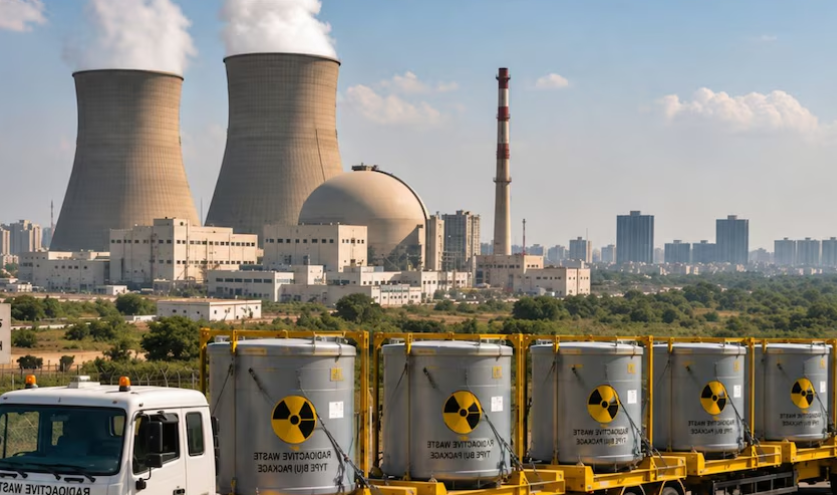
Behind India's Nuclear Power Expansion: Where Does Radioactive Waste Go? Government Details Management Process in Parliament for First Time
India is rapidly advancing its nuclear power expansion, but the safe disposal of radioactive waste is the least-publicized challenge. The government has for the first time detailed in Parliament how it handles hazardous waste. In a written reply, the Department of Atomic Energy disclosed that all nuclear power plants in India generate an average of 0.15 cubic meters (approximately 150 liters) of solid radioactive waste per megawatt (MW) of capacity annually, including waste from operational and decommissioning phases, equivalent to about 1.5 household bathtubs in volume; radioactive waste quantities and disposal records are regularly reported to the Atomic Energy Regulatory Board (AERB). The operation and maintenance of nuclear power plants generate various types of radioactive waste, including spent filter cartridges, protective clothing, tools, equipment, and other items that come into contact with radioactive materials. Waste is categorized into gaseous...
2026-08-03

Rosatom Expects Revenue of $43.2 Billion in 2026
Rosatom expects its revenue to reach $43.2 billion in 2026, driven primarily by new products, international operations, and expansion in nuclear energy, technology, and logistics. The company plans to continue scaling up in the coming years, targeting consolidated revenue of approximately $50.8 billion by 2028, with businesses related to new technologies expected to grow by about 50%. To support this growth target, Rosatom will maintain an investment program exceeding $11.4 billion, focusing on projects that yield the best financial returns. Rosatom is actively implementing cost control and efficiency improvement measures, aiming to increase productivity by 12% annually and achieve a 10% wage increase...
2026-08-03

First Experimental Result Published from the High-Intensity Heavy-Ion Accelerator Facility
Recently, the research team from the Institute of Modern Physics (IMP) of the Chinese Academy of Sciences, together with collaborators, successfully produced and identified the rare isotope hafnium-153 using the High-Intensity Heavy-Ion Accelerator Facility (HIAF). This is the first physics result obtained during the commissioning of HIAF, demonstrating that China's new-generation high-intensity heavy-ion research facility is capable of exploring unknown nuclides and expanding the nuclear chart. It marks the official commencement of HIAF's scientific discovery journey. The result was published as a short communication in *Science Bulletin*. Figure: Position of hafnium-153 on the nuclear chart; the blue line indicates the boundary of known nuclides. Image | Hu Houyu, Li Hongfu. Atomic nuclei are composed of protons and neutrons, and different combinations of proton and neutron numbers form the diverse world of nuclides. Exploring unknown nuclides and investigating the boundaries of nuclear existence are important frontiers in nuclear physics. Hafnium-153 is located in the neutron-deficient heavy-mass region and is an important subject for studying the evolution of nuclear structure and the limits of nuclear stability. It had not been reported prior to this experiment. The discovery and precise measurement of this nuclide will help test nuclear theory models and deepen our understanding of nuclear structure regularities.
2026-08-03

Multinational Team Reveals Mechanisms of Lithiation in Modulating the Structural and Electronic Properties of Borophene Using Synchrotron Techniques
A research team from the Institute of Physics in Zagreb, Croatia, Elettra Synchrotron in Trieste, Italy, Shimane University, and Tokyo University of Science recently conducted a study on the interaction between lithium atoms and borophene, revealing the mechanisms by which lithiation affects the atomic structure and electronic properties of borophene. The findings were published in *ACS Nano* and selected as the journal cover article. (a) Shift of the B 1s core level toward higher binding energy; (b) reduction of the sample work function due to charge transfer from Li atoms to B atoms; (c) lithium atoms (yellow) deposited on borophene (magenta) induce deformation of the borophene lattice, attributed to significant charge redistribution within the system...
2026-08-03

US Utility Xcel Energy's Nuclear Plant Life Extension Boosts Q2 Earnings Significantly
Xcel Energy, a multi-state regulated electric and gas utility headquartered in Minneapolis, USA, achieved significant earnings growth in the second quarter, primarily driven by reduced depreciation expenses resulting from extended operating lives of its nuclear power plants. The company extended the expected operating lives of its nuclear plants to 2050 and beyond, thereby lowering quarterly depreciation costs and positively impacting its financial performance. Despite a decline in operating revenues, net income still grew by 32% to $586 million, with diluted earnings per share rising from $0.75 to $0.93. The extension of nuclear plant operating lives does not imply an immediate increase in cash flow or power generation...
2026-08-03