
Search Results
Keyword:Nuclear Safety

Ghana Acquires Nuclear Power Plant Simulator to Advance Nuclear Talent Training
The Ghana Atomic Energy Commission (GAEC) has installed a nuclear power plant simulator at its simulation center for personnel training, operational procedure drills, and safety capacity building, in preparation for Ghana's future nuclear power program. The facility allows trainees to familiarize themselves with plant control, operations, and emergency response procedures in a controlled environment before the actual construction of a nuclear power plant. George Kofi Appiah, Manager of the Localization and Stakeholder Support Center at the GAEC Nuclear Power Institute, stated that the simulator will help Ghana develop the professional capabilities needed to safely operate nuclear facilities. The remarks were made during a media professionals' tour organized by the Nuclear Power Ghana (NPG)...
2026-08-23

South Korea Approves Restart of Shin-Kori Unit 1
The Nuclear Safety and Security Commission (NSSC) of South Korea announced on August 21 that it has approved the restart of Shin-Kori Unit 1, located in Ulju County, Ulsan. The unit has been under routine inspection since July 2. On the same day, the commission approved the unit to reach criticality. Criticality refers to the state in which a sustained nuclear fission chain reaction can be maintained within the reactor core, with a balanced neutron population. Once criticality is achieved, the reactor can gradually resume operation under safely controlled conditions. The NSSC stated that this routine inspection involved 98 inspection items required before the reactor could reach criticality, of which 86 have been completed, confirming that the unit meets the conditions for safely achieving criticality.
2026-08-22
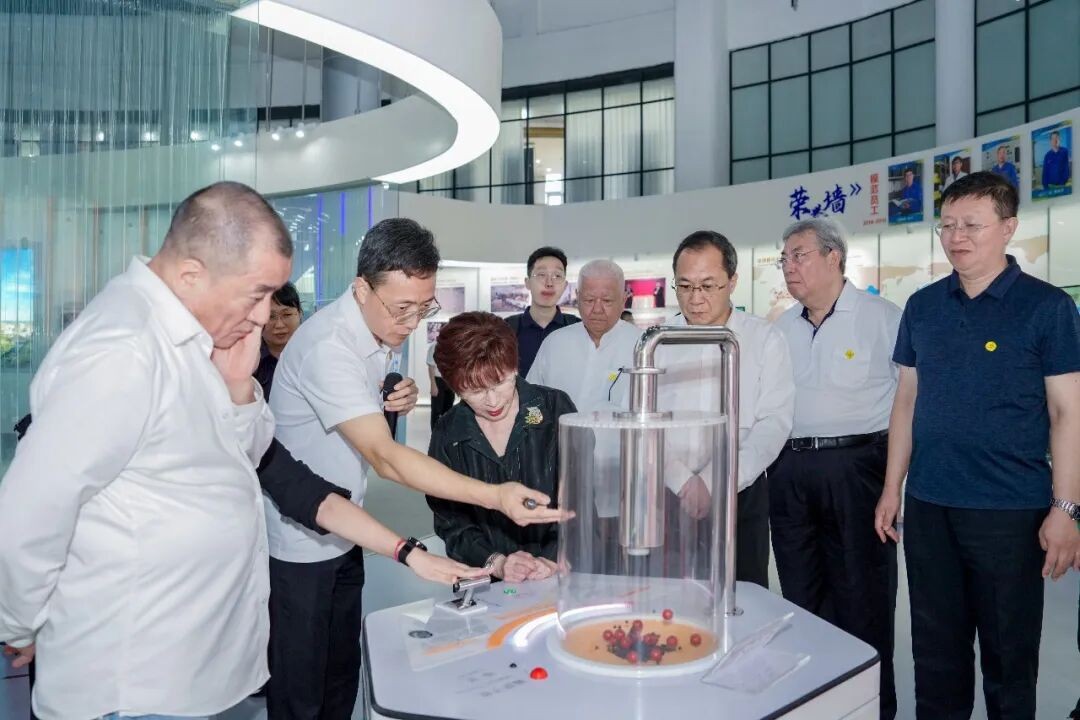
Hung Hsiu-chu, Former Chairman of the Chinese Kuomintang, Visits CGN Yangjiang Nuclear Power Base
From August 15 to 19, the Second Cross-Strait Folk Customs and Sports Festival - Nanhai (Yangjiang) Fishing Season Opening Folk Culture Exchange Activity was held in Yangjiang. Prior to the event, Hung Hsiu-chu, former Chairman of the Chinese Kuomintang and Chairwoman of the China Youth Eagle Peace Education Foundation, led a delegation to visit the CGN Yangjiang Nuclear Power Base on August 15 for an on-site inspection of the nuclear power industry's development achievements. Yang Jianbing, Secretary of the Party Committee and Chairman of Yangjiang Nuclear Power, accompanied the delegation throughout the visit and provided explanations. Zhao Yu, Second-Level Inspector of the Liaison Bureau of the Taiwan Work Office of the CPC Central Committee and the Taiwan Affairs Office of the State Council, Pan Jianyong, Deputy Director of the Taiwan Affairs Office of the Guangdong Provincial Party Committee, Lu Yixian, Secretary of the Yangjiang Municipal Party Committee and Director of the Standing Committee of the Municipal People's Congress, and Li Kun, Secretary of the Yangdong District Party Committee, accompanied the visit. During the visit, Hung Hsiu-chu and her delegation...
2026-08-21

U.S. University Develops Laser De-icing Technology for Nuclear Power Plant Safety System Maintenance
An engineering team at the University of South Florida has developed a customized laser de-icing technology to address the issue of ice basket adhesion in the maintenance of critical safety systems at nuclear power plants. After four years of research, design, and testing, the technology has completed field testing at two nuclear power plants operated by the Tennessee Valley Authority (TVA). Developed jointly by Ahmed Vaselbehagh, Professor of Mechanical and Aerospace Engineering at the University of South Florida, and postdoctoral researcher Ty Hagan, the technology is primarily aimed at ice condenser systems used in certain nuclear power plants in the United States, Japan, and Finland...
2026-08-21

South Korea Amends Nuclear Safety Act to Clarify Safety Responsibilities of Nuclear Facility Operators
The National Assembly of South Korea passed a partial amendment to the Nuclear Safety Act at its 438th special session on August 20, marking the first time that nuclear-related business operators' primary responsibility for nuclear facility safety has been explicitly established at the legal level. This move signifies that South Korea's nuclear safety management system will further transition from a licensing and regulation-centered approach to a responsibility system aligned with the safety principles of the International Atomic Energy Agency (IAEA). The amendment was proposed by South Korean lawmaker Oh Se-hee. Prior to the revision, South Korea's Nuclear Safety Act primarily established safety standards and regulatory procedures around reactor construction and operating licenses, nuclear material use, and radioactive waste management facility operations, but lacked...
2026-08-21

Organizational Diagnostic Assessment Completed at Russia's Smolensk Nuclear Power Plant
Russia's Smolensk Nuclear Power Plant has recently completed an organizational diagnostic assessment under a support mission of the WANO Moscow Centre. The assessment was carried out by a team of eight experts from the WANO Moscow Centre, Rosenergoatom, Beloyarsk Nuclear Power Plant, and Atomflot, among other organizations. Organizational diagnostics is a type of assessment that WANO has been conducting in recent years, focusing not on a single topic but on a comprehensive review of the plant from the organizational and operational perspective. The assessment covered areas including employee...
2026-08-21

Ukraine Approves Expansion of Buryakivka Radioactive Waste Disposal Facility
The State Nuclear Regulatory Inspectorate of Ukraine (SNRIU) has approved the construction of a new disposal facility at the Buryakivka radioactive waste disposal site for the disposal of low- and intermediate-level radioactive waste generated during the cleanup of the Chernobyl nuclear accident. The Buryakivka radioactive waste disposal facility is located within the Chernobyl Exclusion Zone and is one of Ukraine's key facilities for managing radioactive waste associated with the Chernobyl accident. Built as part of priority emergency measures following the accident, the facility was commissioned in 1987 and primarily receives low- and intermediate-level radioactive waste from the Chernobyl region. Currently, the facility is operated by the Central...
2026-08-20

Automatic Shutdown of Unit 4 at South Korea's Hanul Nuclear Power Plant, Regulator Launches Investigation
The Nuclear Safety and Security Commission (NSSC) of South Korea reported on August 19 that Korea Hydro & Nuclear Power Co., Ltd. (KHNP) had reported the same day that Unit 4 of the Hanul Nuclear Power Plant, located in Uljin County, North Gyeongsang Province, automatically shut down at approximately 8:50 a.m. The NSSC stated that Unit 4 of the Hanul Nuclear Power Plant is currently in a stable condition. No abnormal alarms were triggered by on-site radiation monitors, and no leakage of radioactive materials to the outside environment has been detected. According to the notification, the NSSC's regional office for the Hanul Nuclear Power Plant is conducting inspections of on-site safety conditions. The regulatory body also plans to dispatch an investigation team comprising experts from the Korea Institute of Nuclear Safety (KINS) to the site to further confirm the cause of the automatic shutdown and related safety conditions.
2026-08-19

Egypt Clarifies Safety Concerns over Dabaa Nuclear Power Plant: Project Implemented in Accordance with International Nuclear Safety Standards
The Egyptian Cabinet Media Center recently issued a statement responding to questions regarding the application of safety standards during the implementation of the Dabaa Nuclear Power Plant project. The statement said that the circulating content failed to accurately and balancedly reflect the actual situation of the project, and directly extrapolated certain engineering observations into issues of project safety and implementation efficiency, lacking the necessary technical and regulatory context. The Egyptian Nuclear Power Plants Authority stated that the construction of the Dabaa Nuclear Power Plant is proceeding in accordance with international nuclear safety standards, with all civil, engineering, and installation works executed in compliance with international quality requirements and subject to continuous inspections by the Authority's monitoring and supervision teams. Relevant works may only proceed to the implementation phase after completing regulatory procedures and obtaining the necessary approvals from the Egyptian Nuclear and Radiological Regulatory Authority...
2026-08-18

Finland's Olkiluoto 3 unit reduces power output due to main coolant pump fault
Finnish utility Teollisuuden Voima (TVO) said on August 17 that Unit 3 of the Olkiluoto nuclear power plant (OL3) will continue to operate at a stable power output of approximately 1,300 MW, about 84% of full capacity, for the coming weeks due to technical faults in two main coolant pumps in the nuclear island. The unit's rated generating capacity is approximately 1,600 MW. TVO stated that the faults were discovered during this summer. Since then, the unit has reduced its output power and investigations have been conducted into the causes of the faults and corrective measures. Under the latest arrangement, OL3 will continue operating at a reduced power level to monitor the effectiveness of corrective actions until the unit begins its scheduled annual outage on September 10, 2026. TVO...
2026-08-18

China National Nuclear Power Deeply Studies and Practices the Ecological Environment Code, Undertaking the Historic Mission of Green and Low-Carbon Energy Transition
The Ecological Environment Code of the People's Republic of China (hereinafter referred to as the Ecological Environment Code) officially came into effect on August 15, 2026. The Ecological Environment Code is an important achievement in implementing Xi Jinping's Thought on Ecological Civilization and Xi Jinping's Thought on the Rule of Law. It is the second law in China named after a "Code" following the Civil Code of the People's Republic of China, providing solid legal safeguards and fundamental legal guidance for the construction of a Beautiful China. China National Nuclear Power Co., Ltd. (hereinafter referred to as China National Nuclear Power), as a main force in China's nuclear energy development and an important force in achieving the "dual carbon" goals, deeply implements the Ecological Environment Code, practices the concept of green development, contributes safe and clean energy, and empowers the construction of a Beautiful China...
2026-08-18

Safety measure costs after Japan's nuclear plant accident rise to at least 6.606 trillion yen
A survey of 11 Japanese electric power companies shows that the total cost of safety measures required for nuclear plants to meet new regulatory standards following the Fukushima Daiichi accident has reached at least 6.606 trillion yen. Affected by rising prices, this figure has increased slightly from the previous year. About half of the surveyed companies said that rising costs of materials, equipment, and construction have pushed up related expenses, and the total may continue to rise in the future. After the Fukushima Daiichi accident, Japan implemented new nuclear regulatory standards requiring plants to strengthen earthquake and tsunami protection and improve severe accident response measures. Related costs mainly include seawalls, emergency power supplies, filtered venting equipment, and...
2026-08-18
Vietnam Electricity Advances Preparatory Work for Ninh Thuan 1 Nuclear Power Plant
Vietnam Electricity (EVN) is advancing preparatory work for the Ninh Thuan 1 Nuclear Power Plant project, focusing on supporting measures in legal framework, financial arrangements, project management, human resource development, and public communication. The project is regarded as Vietnam's first nuclear power plant project and holds significant importance for ensuring energy security, promoting energy structure transition, and reducing carbon emissions. During the 7th National Nuclear Regulatory Conference, EVN Deputy General Director Nguyen Thai Anh stated that the Ninh Thuan 1 Nuclear Power Plant project must meet the highest technical, engineering, and safety requirements currently applicable in Vietnam. In the preparatory phase, EVN is focusing on addressing three categories of challenges while simultaneously advancing five groups of solutions to ensure the project proceeds in accordance with...
2026-08-17

Repeated Power Outages at Zaporizhzhia Nuclear Power Plant Raise Concerns over Equipment Aging and Safety Risks
August 13 news, the issue of repeated interruptions to the external power supply at the Zaporizhzhia Nuclear Power Plant continues to draw attention. Relevant data shows that since February 2022, the plant has experienced 26 power outages, 14 of which occurred in the first 8 months of 2026. The Zaporizhzhia Nuclear Power Plant is the largest nuclear power plant in Europe. Once the external power supply is interrupted, the plant must switch to backup power to maintain the operation of essential safety systems. Frequent switching of power supply modes not only increases operational pressure but also poses additional risks to nuclear safety and radiation safety. Relevant parties have stated that signs of equipment aging at the Zaporizhzhia Nuclear Power Plant are intensifying, with the condition of diesel generator sets being particularly concerning. The backup diesel generator sets are generally...
2026-08-15

The Ecological Environment Code of the People's Republic of China Officially Takes Effect Today
On August 15, 2026, coinciding with the fourth National Ecology Day, the Ecological Environment Code of the People's Republic of China officially took effect. The promulgation and implementation of this Code marks the formal entry of China's ecological environment protection legal system into a new stage of codification, representing a major milestone in the rule of law for advancing ecological civilization construction and the building of a Beautiful China. The Code's promulgation: A historic leap in the rule of law for ecological civilization construction. The Ecological Environment Code of the People's Republic of China is the second foundational law named as a "Code" after the Civil Code. The Code systematically integrates existing effective laws and regulations in areas including environmental protection, air pollution prevention and control, water pollution prevention and control, soil pollution prevention and control, solid waste pollution prevention and control, radioactive pollution prevention and control, and noise pollution prevention and control. It abolishes 10 separate laws, incorporates the essential provisions of more than 20 laws into the Code system, and makes comprehensive provisions on basic principles of ecological environment protection, supervision and management systems, pollution prevention and control, ecological protection and restoration, green and low-carbon development, and climate change response, establishing a complete and logically rigorous legal norm system. The Code also makes comprehensive provisions on radioactive pollution prevention and control...
2026-08-15