
Search Results
Keyword:Unit 3

Unit 3 of Beloyarsk NPP begins scheduled maintenance and equipment modernization
Unit 3 of Russia's Beloyarsk NPP entered scheduled preventive maintenance on August 18. This outage maintenance will be used for fuel reloading, equipment maintenance, and preventive repairs, along with partial modernization efforts to maintain reliable unit operation and improve equipment performance. The unit features a BN-600 sodium-cooled fast neutron reactor. During the maintenance period, the plant will carry out major repairs on the BN-600 reactor facility and replace 9 guide tubes in the control and protection system. Such operations are uncommon and are typically performed approximately once every 10 years. According to the maintenance schedule, the plant will also repair the unloading lift device and conduct operational monitoring inspections of the reactor pressure vessel metal...
2026-08-19
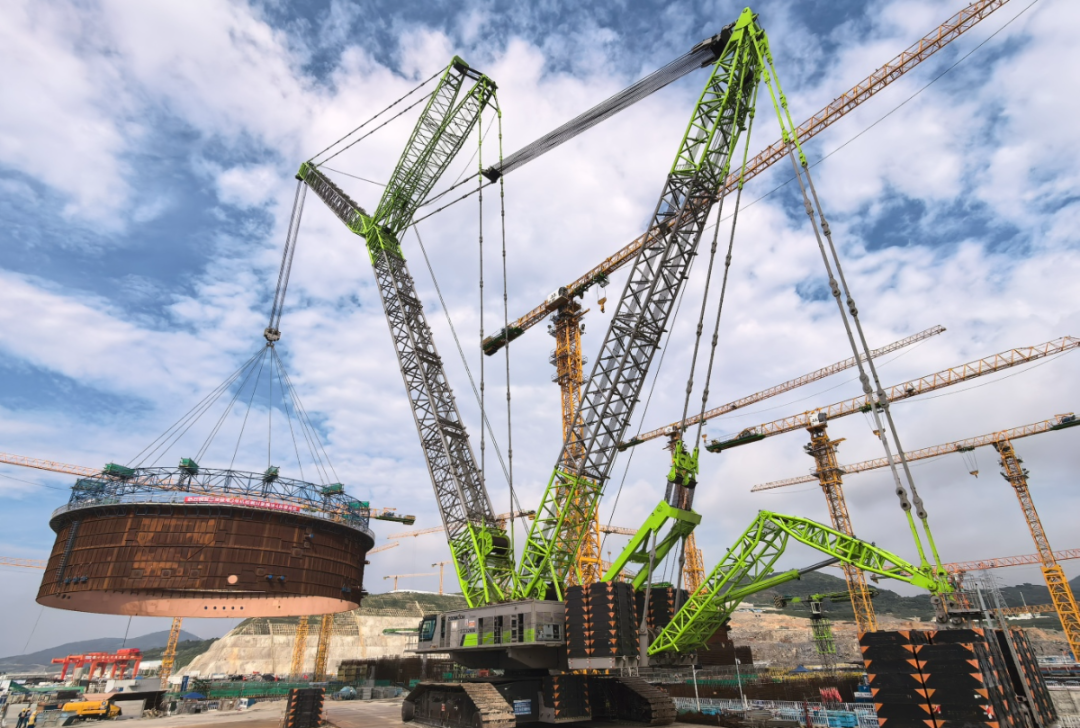
Module 4 of Steel Liner for Unit 3 of San'ao Nuclear Power Plant Successfully Hoisted
At 8:16 a.m. on August 15, the hoisting operation of Module 4 of the 3BRX steel liner for Unit 3 of the San'ao Nuclear Power Plant was officially launched. Under the stable operation of the 2,000-ton crawler crane of CNNC Machinery Engineering, the module successively completed a series of procedures including slewing, load-bearing travel, and alignment adjustment. After 220 minutes, the hoisting task was successfully completed. Module 4 of Unit 3 hoisted this time was integrally assembled from the fourth and fifth layers of the cylinder, with a diameter of approximately 45 meters and a height of 11.46 meters. The module features a large volume, susceptibility to deformation, and limited slewing space for the crane. The project team strictly implemented the special plan, completed site reinforcement, transport of baskets and counterweights, and crawler crane relocation in advance, organized hoisting simulation drills, and comprehensively inspected various safety hazards...
2026-08-18

SPIC Haiyang Nuclear Power Unit 3 Hot Functional Test Successfully Completed
At 17:30 on August 13, the hot functional test (HFT) of Unit 3 at SPIC Shandong Nuclear Power Haiyang Nuclear Power Plant was successfully completed, laying a solid foundation for subsequent fuel loading and first grid connection of the unit. ▲Aerial view of Shandong Nuclear Power Haiyang Nuclear Power Plant. The hot functional test is the most critical non-nuclear comprehensive verification phase before nuclear fuel loading, often referred to as the "final exam" or "mock exam" before a nuclear power plant officially generates electricity. By executing a series of tests simulating actual operating conditions within the pressure and temperature ranges of normal reactor operation, it comprehensively verifies the reliability of nuclear island and conventional island systems and equipment under hot operating conditions, ensuring that relevant parameters meet design requirements. ▲On July 4, during the normal residual heat removal system (RNS) test at the heat-up platform of the hot functional test...
2026-08-15

Module 5 of Containment Steel Liner Successfully Lifted at Unit 3 of Guangdong Taipingling Nuclear Power Plant
On August 10, the construction of Unit 3 at CGN's Guangdong Taipingling Nuclear Power Plant reached a critical milestone. A Zoomlion 2,000-tonne crawler crane, serving as the core lifting main force, successfully completed the precise positioning of Module 5 of the containment steel liner. This lifting operation involved significant technical challenges and demanding working conditions. The steel liner Module 5 weighed nearly 280 tonnes, with a component diameter of 45 meters, a height of nearly 6 meters, and a wall thickness of only 6 millimeters, making it a typical ultra-large thin-walled flexible component. The module's lateral windward area exceeded 300 square meters, making it susceptible to wind-induced sway during lifting, which imposed extremely high requirements on the crane's operational stability, control precision, and heavy-load adaptability. The Zo...
2026-08-14

Automatic Reactor Trip at Unit 3 of Shin-Kori Nuclear Power Plant During Commissioning
Unit 3 of the Shin-Kori nuclear power plant in Ulju, Ulsan, South Korea, is undergoing commissioning ahead of its planned commercial operation this year. The Nuclear Safety and Security Commission (NSSC) stated that it had received a report from Korea Hydro & Nuclear Power (KHNP) that the unit's reactor automatically tripped at approximately 20:56 on the 11th. Unit 3 of the Shin-Kori plant received its operating license from the NSSC in December last year and is currently in the power ascension testing phase. KHNP reported that during the commissioning test, when reactor power reached 80%, the unit experienced a loss of power transmission, and the reactor subsequently tripped automatically. The unit has been confirmed to remain in a safe shutdown condition...
2026-08-12

Automatic Shutdown of Unit 3 at Oi Nuclear Power Plant During Operation; Kansai Electric Power to Investigate Cause from the 12th
Unit 3 of the Oi Nuclear Power Plant in Fukui Prefecture, Japan, experienced an automatic shutdown during operation in the early hours of the 9th. Operator Kansai Electric Power stated that the fault is related to an internal abnormality in the generator and plans to formally begin a cause investigation from the 12th. Currently, there is no clear timeline for when the unit can resume operation. According to reports, an alarm related to loss of magnetic field occurred inside the generator used for power generation at the time of the incident, after which the generator stopped, and the reactor in operation also automatically shut down. On the 10th, Kansai Electric Power visited the Fukui Prefectural Government to apologize for the fault and report on subsequent response measures. Yuichiro Sakamoto, head of the Fukui Prefecture Disaster Prevention and Safety Division, pointed out that following a steam leak fault at Mihama Nuclear Power Plant Unit 3 in May this year, an unexpected emergency shutdown of a reactor in operation occurring within a short period may undermine public trust in nuclear safety. Local government authorities have demanded that the operator promptly identify the cause and implement measures to prevent similar issues from recurring.
2026-08-11

Unit 3 of Japan's Ohi Nuclear Power Plant Automatically Shuts Down
Kansai Electric Power Co. announced in the early hours of the 9th that Unit 3 of the Ohi Nuclear Power Plant, located in Ohi Town, Fukui Prefecture, Japan, automatically shut down during operation. The unit has a generating capacity of 1.18 million kilowatts. According to Kansai Electric Power, at around 23:56 on the 8th, an alarm was triggered at the unit, indicating that the generator had lost the conditions required to produce a magnetic field. Subsequently, the generator automatically stopped operating, and the reactor also automatically shut down. Preliminary information suggests that the anomaly may involve the exciter, a device used to establish the magnetic field for the generator. Kansai Electric Power stated that no radioactive material leakage occurred as a result of this incident, and there was no radiological impact on nearby personnel or the environment. The cause of the malfunction...
2026-08-10

Belarus Plans Nuclear Expansion: BelAES Unit 3 and Second NPP in Mogilev Region to Advance in Parallel
Belarusian Energy Minister Denis Moroz recently stated that nuclear energy has become a strategic energy direction for Belarus, bearing on national energy security, economic growth, and technological sovereignty. Since the Belarusian Nuclear Power Plant was commissioned, it has helped the country reduce its dependence on imported natural gas, cumulatively replacing approximately 14.5 billion cubic meters of natural gas and saving over $600 million in budget funds. After assessing the multiplier effect of nuclear power on the economy, Belarus has decided to continue advancing its nuclear energy development. Moroz stated that the country has made a principled decision: on the one hand, to build a third unit at the Belarusian Nuclear Power Plant (BelAES) in Ostrovets, and on the other hand, to simultaneously study the plan for constructing a second nuclear power plant.
2026-08-09

New Decommissioning Plan for Fukushima Daiichi: Priority on Internal Investigation of Unit 3 Before Fuel Debris Retrieval
The Nuclear Damage Compensation and Decommissioning Facilitation Corporation of Japan released on August 6 an outline of the 2026 edition of the "Decommissioning Strategic Plan," proposing technical approaches for the decommissioning of Tokyo Electric Power Company's Fukushima Daiichi Nuclear Power Station. The plan highlights that, for the large-scale retrieval of melted fuel debris at Unit 3, expected to commence in or after fiscal year 2037, priority should currently be given to internal investigations of the reactor building to provide a more reliable basis for subsequent engineering plans. The plan states that the fuel debris retrieval method being studied by TEPCO still requires further improvement in certainty, with the key prerequisite being an understanding of the actual internal conditions of the reactor. Due to the high radiation levels of the water inside the unit following the accident...
2026-08-07

Approximately 13,000 liters of water found in Unit 3 of Hamaoka Nuclear Power Plant; Chubu Electric continues investigation into data falsification
Japan's Chubu Electric Power announced on August 4 that water accumulation totaling approximately 13,000 liters was found in the turbine building and related areas of Unit 3 at the Hamaoka Nuclear Power Plant. The company stated that the accumulated water contains no radioactive substances and is currently investigating the specific cause. According to Chubu Electric Power, at around 11:00 a.m. on the 4th, a worker from a partner company discovered approximately 5 liters of water in a passageway on the northwest side of the first basement floor of the turbine building adjacent to the reactor building of Unit 3. Subsequently, company personnel continued on-site inspections and confirmed at around 3:00 p.m. the same day that approximately 13,000...
2026-08-05

Pre-Startup Review (PSUR) for Sanmen Nuclear Power Plant Unit 3 Completed
From July 15 to 30, the Pre-Startup Review (PSUR) for Sanmen Nuclear Power Plant Unit 3 was conducted at the Sanmen nuclear power plant site. The review was organized by the Shanghai Office of the World Association of Nuclear Operators (WANO), and the review team consisted of 21 experts from the WANO Shanghai Office, WANO Tokyo Center, and Korea Hydro & Nuclear Power Co., Ltd. Leaders of Sanmen Nuclear Power Company and personnel from relevant fields participated in this activity. The review aimed to systematically and comprehensively evaluate the readiness of Unit 3 prior to startup, identify areas for improvement, analyze causes, and propose improvement recommendations. Through site inspections, work observations, document package reviews, and personnel interviews, the WANO review team conducted a thorough assessment of...
2026-08-03

Unit 3 of the Huaneng Changjiang Nuclear Power Phase II project—Hainan Province's first "Hualong One" nuclear power project—has been connected to the grid and is generating electricity
On August 1, Unit 3 of the Huaneng Changjiang Nuclear Power Phase II Project, the first large-scale pressurized water reactor nuclear power project under controlling construction by China Huaneng Group Co., Ltd. and the first "Hualong One" nuclear power project in Hainan Province, was connected to the grid, generating Huaneng's first kilowatt-hour of pressurized water reactor nuclear power. This marks that the unit has officially gained the capability to transmit power to the grid, taking a key step toward the goal of commercial operation. The project plans to build two 1.2-million-kilowatt nuclear power units, equipped with China's independently developed third-generation pressurized water reactor nuclear power technology, the "Hualong One." It vigorously promotes the independent design of nuclear power and the localization of equipment manufacturing, and adopts a safety design concept combining active and passive systems, which can significantly improve the reliability and safety of the nuclear power plant. ...
2026-08-03

Hungary's Paks Nuclear Power Plant Faces Full Shutdown Due to Record Low Danube Water Level
Affected by persistent drought and high temperatures, the water level of the Danube River at the Budapest section dropped to 23 cm (fixed datum reading, a record low), restricting cooling water intake at the Paks Nuclear Power Plant. Starting Wednesday, July 29, Unit 3 was the first to be shut down; the operator, MVM Paks Nuclear Power Plant Ltd, subsequently stated on its official website that all four units would inevitably be disconnected within the next 24 to 72 hours, with power generation coming to a complete halt. MVM explained that the existing water volume of the Danube is still sufficient to cool the reactors, but the intake pumps can no longer draw water because the riverbed is exposed and the pump inlets are too far from the water surface—an equipment failure rather than an absolute shortfall in cooling water volume. To this end, the Hungarian side deployed 4 pumping barges and 2 floating cranes near the plant as an emergency measure, but with water levels expected to continue falling, a preventive full shutdown remains unavoidable.
2026-07-31

Restart of Tomari Nuclear Power Plant Unit 3 Delayed to After End of 2027
Hokkaido Electric Power Co. announced on July 30 that the restart of Unit 3 at the Tomari Nuclear Power Plant will be significantly delayed compared to earlier expectations, with the earliest possible date being the end of 2027 or later. Previously, the company had set a target of restarting as early as possible within 2027, but due to delays in the seawall construction project and the fact that the Nuclear Regulation Authority (NRA) has not yet completed its review of the relevant design and construction plans, the timeline for the unit's return to operation remains uncertain. Hokkaido Electric Power President Susumu Saito stated at a press conference that the seawall at the Tomari plant was originally scheduled for completion in the spring of 2027, but is now expected to be finished by mid-August 2027 due to additional work such as seismic reinforcement of the wharf and liquefaction countermeasures...
2026-07-31

Fuel unloading completed for Unit 3 of Dukovany Nuclear Power Plant
On July 30, Unit 3 of the Dukovany Nuclear Power Plant completed the unloading of reactor fuel assemblies, and the planned refueling outage has now entered its next phase. During this outage, the plant will replace part of the nuclear fuel and carry out hundreds of inspections, tests, and maintenance activities to enhance nuclear safety levels and ensure the long-term stable operation of the unit. In this outage, although the actual number of fuel assemblies to be replaced accounts for about one-fifth of the total, operators must first remove all fuel assemblies from the entire core and transfer them to the spent fuel pool. Subsequently, the reactor water level will be lowered to create conditions for maintenance of core cooling system components and inspection of some primary circuit equipment...
2026-07-30