
Search Results
Keyword:ZE

Indonesia Incorporates Nuclear Energy into Decarbonization and Power Planning
The National Energy Council (DEN) of Indonesia recently stated that nuclear energy is expected to become an important option for driving the country's energy transition and achieving its net-zero emission targets. DEN member Sripeni Inten Cahyani said at a national energy policy promotion event held at Mataram University that the positioning of nuclear energy in Indonesia's energy planning is changing, and it is no longer just a last resort. Sripeni Inten Cahyani (right), a member of the National Energy Council (DEN), accompanied by fellow member Surono (left), gave an exclusive interview to reporters after a national energy policy outreach activity at Mataram University in West Nusa Tenggara Province on Thursday, August 20, 2026...
2026-08-21

CERN Injector Complex Enters Final Beam Run Phase Before LS3
The CERN accelerator complex is entering its final operational phase before the third Long Shutdown (LS3). With the Large Hadron Collider (LHC) having already entered LS3, the injector complex and associated facilities will continue high-intensity beam operations until 6:00 a.m. on Monday, August 31, after which the operations team will hand over control to the LS3 coordination team, marking the formal transition of the entire accelerator complex into the shutdown maintenance phase. August 19, 2026, page one of the SPS. The third run of the injector complex is drawing to a close. (Image: CERN) During the final week-plus of operations, CERN will continue delivering proton and ion beams to physics experiments.
2026-08-21

Large Hadron Collider experiments reveal neon nucleus may be bowling-pin shaped
A recent experimental result from the Large Hadron Collider at CERN suggests that the internal structure of the neon-20 nucleus may not be approximately spherical as commonly depicted in traditional textbooks, but rather closer to a "bowling pin" shape. This finding provides new experimental clues for studying deformation of light atomic nuclei and collective behavior in high-energy nuclear collisions. Atomic nuclei are composed of protons and neutrons, determining the elemental identity of atoms and carrying most of their mass. Although nuclei are often simplistically depicted as spherical, nuclear physics research has shown that some nuclei exhibit pronounced non-spherical deformation, such as the pear-shaped nuclei mentioned in previous studies. Accurately understanding these shapes helps physicists...
2026-08-21

U.S. SYNOPTICS Produces Large-Size Yb:YLF Crystal for Inertial Confinement Fusion Laser Systems
On August 19, SYNOPTICS, a subsidiary of Northrop Grumman, announced that it had successfully grown and harvested a large-size ytterbium-doped yttrium lithium fluoride crystal, namely a Yb:YLF crystal ingot. The crystal measures approximately 127 millimeters at its widest point, with a diameter three times the industry standard. SYNOPTICS stated that as laser engineering continues to expand toward higher efficiency and higher power, the demand for gain media with larger apertures and larger dimensions continues to grow. The Yb:YLF crystal produced this time is approximately 20% larger than the largest crystal the company had previously grown, and approximately 50% larger than the company's conventional product size. Kevin Stevens, General Manager of SYNOPTICS, stated that yttrium lithium fluoride is a commonly used host material for laser-active rare-earth ions, and scaling up the growth of YLF crystals will help laser engineers continue to raise the upper limit of achievable laser output power. He said that such materials are of significant importance for applications including directed energy, inertial confinement fusion, and industrial laser systems. Stevens also stated that Yb:YLF crystals can be used in applications requiring reduced thermal lensing effects and enhanced pulsed energy storage capability, while also leveraging their natural birefringent host to achieve polarization characteristics. According to information recently released by SYNOPTICS, some of the crystals will be used in the high-energy laser system at the German Electron Synchrotron Research Center (DESY) to support its inertial confinement fusion energy research. The company is currently studying the feasibility of further scaling up the size of Yb:YLF crystals, and plans to extend the relevant processes to other rare-earth-ion-doped YLF crystals, including holmium, thulium, and neodymium doping systems.
2026-08-21

U.S. Apollo Atomics Secures $31 Million in Funding to Advance Commercialization of Compact Pressurized Water Reactor
U.S.-based Apollo Atomics recently announced the completion of a $31 million seed funding round to advance the commercialization of its next-generation compact pressurized water reactor. Incubated by the Massachusetts Institute of Technology (MIT) and backed by Y Combinator, the company plans to shift the reactor from the traditional one-off large-scale construction model to a factory-manufactured, scalable product. The round was led by FCVC, with participation from Y Combinator, Telesoft Partners, Alumni Ventures, Robinhood Ventures, Nucleation Capital, Pelion VC, and Duke Capital Partners. The company stated that the proceeds will be used to...
2026-08-21

CERN measures niobium-94 neutron capture for the first time, shedding new light on the mystery of molybdenum abundance in ancient stardust
The n_TOF collaboration at CERN recently reported that researchers have for the first time measured the probability of neutron capture by niobium-94. The results, published in Physical Review Letters, provide new experimental evidence for explaining the anomalous abundance of molybdenum-94 in presolar grains. The EAR2 facility in the n_TOF experiment at CERN produces intense neutron beams, opening new possibilities for nuclear research. Credit: CERN Niobium-94 is a niobium isotope containing 41 protons and 53 neutrons, occupying a critical juncture in the nuclear reaction chain that produces heavy elements in dying stars. Researchers are interested in it because niobium-94 is very close to molybdenum-94, differing by just one fewer proton and one more neutron. Under the high-temperature, high-pressure conditions inside stars, niobium-94 may either transform into molybdenum-94 through beta decay or form niobium-95 through neutron capture. The competition between these two reaction pathways directly affects scientists' understanding of the origin of molybdenum-94.
2026-08-20

Firefly Aerospace to Fly Zeno Power Radioisotope Heater to Validate Lunar Night Survival Capability
Firefly Aerospace announced on August 19 that it has reached a commercial payload agreement with Zeno Power Systems to carry Zeno's Lunar Night Survival Package and radioisotope heater unit on a Blue Ghost lunar lander mission. The mission is scheduled to launch no earlier than 2028 and aims to verify whether the relevant nuclear power technologies can help spacecraft, lunar infrastructure, and future lunar base systems continue operating through the long, extremely cold lunar night environment. *Rendering of Firefly's Blue Ghost lunar lander with Zeno Power's Lunar Night Survival Package on its top deck. Under the plan, Zeno's payload will travel with Blue Ghost to the lunar nearside...
2026-08-20
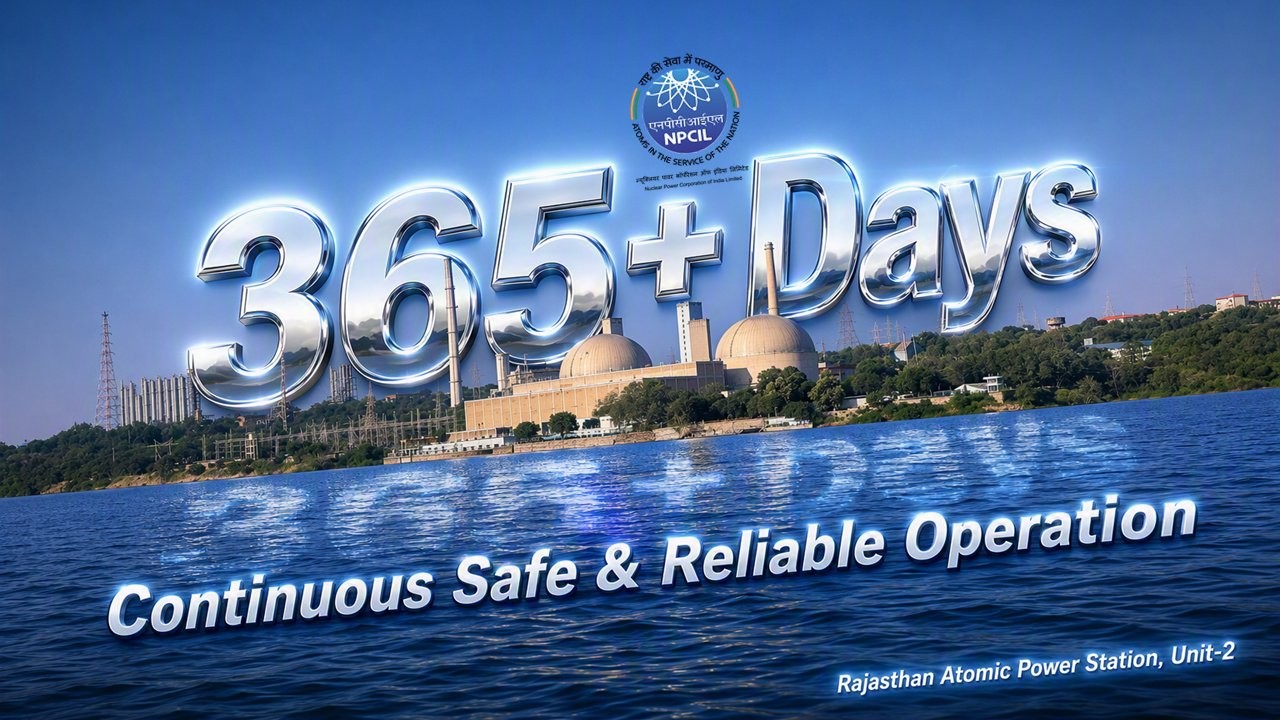
Rajasthan Atomic Power Station Unit 2 Achieves First Full Year of Continuous Operation
Rajasthan Atomic Power Station Unit 2 (RAPS-2) achieved one full year of continuous operation on August 15, 2026. This marks the first time the unit has completed a full year of uninterrupted operation since it was commissioned, coinciding with India's 80th Independence Day. RAPS-2 is operated by the Nuclear Power Corporation of India Limited (NPCIL) and is one of the oldest pressurized heavy water reactor (PHWR) units still in operation by the company. This milestone of one full year of continuous operation is regarded as a significant reflection of the unit's operational management and equipment maintenance standards. Relevant information indicates that this operational record reflects the sustained commitment of Units 1 and 2 at the Rajasthan Atomic Power Station in safety culture, aging management, technical support, and operational organization, and also demonstrates the collaborative efforts of the on-site operations, maintenance, engineering, and support teams in ensuring stable unit operation.
2026-08-19

SHINE Joins GE Vernova-Led Project to Modernize Nuclear Fuel Reprocessing Materials Accountability
SHINE Technologies (SHINE) announced on August 18 that it has joined a nuclear fuel reprocessing materials management project led by GE Vernova (GE Vernova), with both parties collaborating on tracking, measurement, and nuclear materials accountability of spent fuel during the reprocessing process. The project is led by GE Vernova's Advanced Research Center and funded by the U.S. Department of Energy's Advanced Research Projects Agency-Energy (ARPA-E), with the goal of introducing artificial intelligence technologies into reprocessing facilities to improve real-time monitoring of spent fuel flow and the efficiency of nuclear materials accounting. As a subcontractor to GE Vernova, SHINE will participate in improving sensor deployment schemes and developing an AI-supported materials tracking system, ensuring that nuclear materials control and accountability requirements are incorporated into the overall design at the early stages of reprocessing facility development.
2026-08-19

Egypt Clarifies Safety Concerns over Dabaa Nuclear Power Plant: Project Implemented in Accordance with International Nuclear Safety Standards
The Egyptian Cabinet Media Center recently issued a statement responding to questions regarding the application of safety standards during the implementation of the Dabaa Nuclear Power Plant project. The statement said that the circulating content failed to accurately and balancedly reflect the actual situation of the project, and directly extrapolated certain engineering observations into issues of project safety and implementation efficiency, lacking the necessary technical and regulatory context. The Egyptian Nuclear Power Plants Authority stated that the construction of the Dabaa Nuclear Power Plant is proceeding in accordance with international nuclear safety standards, with all civil, engineering, and installation works executed in compliance with international quality requirements and subject to continuous inspections by the Authority's monitoring and supervision teams. Relevant works may only proceed to the implementation phase after completing regulatory procedures and obtaining the necessary approvals from the Egyptian Nuclear and Radiological Regulatory Authority...
2026-08-18

Rostov NPP Transfers New Specialized Firefighting Vehicle to Fire Department
On August 17, local time, the Rostov Nuclear Power Plant handed over a new specialized firefighting vehicle to the 9th Special Department responsible for fire protection at the plant site. The vehicle was delivered as donated equipment to commemorate the 40th anniversary of the 72nd Special Directorate of the Federal Fire Service of the Russian Emergency Situations Ministry. This directorate is tasked with fire protection for Russian nuclear power plants. The professional firefighting force at the Rostov NPP has been on duty at the plant site since June 1984. At that time, the fire brigade was equipped with only four fire engines. Over the years, the relevant firefighting force has been outfitted with modern vehicles, specialized equipment, and communications gear for fire protection and emergency response at nuclear power plant facilities. The 9th Special Department...
2026-08-18

Huaneng Nuclear Energy Research Institute Conducts First Specialized Training on Hualong One System Principles
To enhance the Institute's technical support services and scientific research capabilities regarding Hualong One technology, and to strengthen employees' systematic understanding of Hualong One, Huaneng Nuclear Energy Research Institute organized training on Hualong One system principles, completing the first specialized session on August 12. A total of 101 company leaders and employees participated in the training through a combination of online and offline methods. The first training session reviewed China's path toward independent development of pressurized water reactor technology from an industry development perspective, systematically outlining the global evolution of nuclear power technology and the safety design criteria for Generation III nuclear power. By benchmarking against mainstream Generation III reactor designs such as the US AP1000 and European EPR, the session provided in-depth explanations of Hualong One's dual safety architecture combining active and passive safety systems...
2026-08-18

SwissFEL Achieves Ultralow-Temperature X-ray Observation of Quantum States
Researchers at the Paul Scherrer Institute (PSI) in Switzerland recently reported that the Cristallina experimental station of the Swiss Free-Electron Laser (SwissFEL) can now observe quantum states that only emerge at extremely low temperatures using X-ray scattering at temperatures close to absolute zero. Simon Gerber (left) and Bill Pedrini (right) at the Cristallina experimental station of SwissFEL. With the help of a custom-built cryostat connected to the beamline (far left), quantum states can now be studied at extremely low temperatures. Paul Scherrer Institute PSI/Markus FischerAccording to the team, they recently achieved a low temperature of 35 millikelvin in experiments...
2026-08-17

Neutron and X-ray tomography reveal hydrogen-rich regions in Martian meteorite "Black Beauty"
An international team of researchers from Denmark, Sweden, and Switzerland recently conducted a three-dimensional non-destructive analysis of a slice of the Martian meteorite NWA 7034 "Black Beauty" using neutron tomography and X-ray tomography, discovering macroscopic hydrogen-rich regions within it. The study suggests that these hydrogen-rich features provide evidence of early water-rock interactions on Mars. The findings have been published in Geophysical Research Letters. Black Beauty is a brecciated meteorite from Mars that was ejected into space by an impact event and eventually landed in the Sahara Desert in Morocco. Weighing approximately 320 grams, the meteorite contains material up to 4.48 billion years old, making it one of the oldest known Martian crustal fragments...
2026-08-17

India Releases Detailed Project Report for 300 MWe Bharat Small Modular Reactor
The release of the Detailed Project Report (DPR) for India's 300 MWe Bharat Small Modular Reactor (BSMR-300) marks a new milestone in India's indigenous small modular reactor program. The report was released on August 14, 2026, and was jointly prepared by the Bhabha Atomic Research Centre (BARC) and the Nuclear Power Corporation of India Limited (NPCIL). The project falls under the indigenous Small Modular Reactor (SMR) program advanced by India's Department of Atomic Energy (DAE), positioned as a complement to India's existing large-scale nuclear power construction projects and offering captive nuclear power solutions. According to the released information, the BSMR-300 is designed as a fully indigenously developed Generation III+ pressurized water reactor with an installed capacity of 300 MWe. The project continues...
2026-08-17