
Search Results
Keyword:ESS

Russian Researchers Develop High-Wear-Resistant Steel Sample for Nuclear Waste Processing
Novosibirsk State Technical University (NSTU) recently announced that Russian researchers have developed a steel sample with reinforcing elements. Experimental results show that the durability of this material is approximately 4 times that of 5KhNM tool steel currently used in nuclear power plant waste processing equipment. The research focuses on improving precipitation hardening steel structures. Precipitation hardening steel is a special class of alloy material that, after quenching and holding at specific temperatures, precipitates fine, hard particles within the steel, thereby enhancing strength and wear resistance. The researchers aim to replace existing 5KhNM tool steel with new high-strength alloys...
2026-08-04

Czech Republic Leads EU Project to Assess Application of Commercial-Grade Items in VVER Nuclear Power Plants
The Czech State Office for Nuclear Safety (SÚJB) has launched a two-year EU project focused on assessment methodologies for the application of high-quality commercial-grade items in nuclear power plants equipped with VVER reactors. The project aims to establish a unified, expert-judgment-based evaluation process that provides methodological support for nuclear facilities when introducing relevant items, while ensuring that nuclear safety requirements are not compromised. As the nuclear power supply chain landscape evolves, certain plant-specific components may face the need to be replaced by commercial-grade products. In response, regulatory authorities need to establish clear rules to review the suitability, quality assurance, and safety implications of substitute items. The project will focus on evaluating...
2026-08-04

New Progress in Ion Dynamics Regulation in Nanofluidic Memristors by the Institute of Modern Physics, Chinese Academy of Sciences
Water-based nanofluidic ionic devices offer unique advantages in frontier fields such as brain-computer interfaces and biocompatible computing. Recently, the research team from the State Key Laboratory of Heavy Ion Science and Technology at the Institute of Modern Physics, Chinese Academy of Sciences, in collaboration with Lanzhou University, Hebei University of Geosciences, and other partners, successfully achieved stable ionic memristive effects in single-ion-track nanochannels. Through precise regulation, they realized programmable transitions between memristive and synaptic functions, providing a new technological pathway for the development of next-generation low-power neuromorphic computing hardware. The related results were published in the journal *Small* on July 22. Relying on the Heavy Ion Research Facility in Lanzhou (HIRFL), the researchers...
2026-08-04

Second Ring of Steel Containment Vessel for Reactor Building of Unit 2 at Xudabao Nuclear Power Plant Successfully Hoisted into Place
At 9:57 on August 4, the second ring of the steel containment vessel (hereinafter referred to as CV Ring 2) for the reactor building of Unit 2 at Xudabao Nuclear Power Plant was successfully hoisted into place. The CV Ring 2 hoisted this time is the third ring segment of the steel containment vessel for Unit 2, with a hoisting weight of nearly 890 tons. During the assembly phase, the installation of multiple discipline items, including annular air ducts, steel structural annular corridors, and U-shaped supports for air turbulence, was completed simultaneously for this module, effectively reducing the risk of cross-operation interference in subsequent internal construction of the nuclear island. This approach fully leveraged the advantages of modular construction and effectively translated the concept of "modularize wherever applicable, prefabricate wherever installable" into tangible engineering outcomes. During the assembly and hoisting of CV Ring 2 for Unit 2, Liaoning Nuclear Power, in collaboration with...
2026-08-04
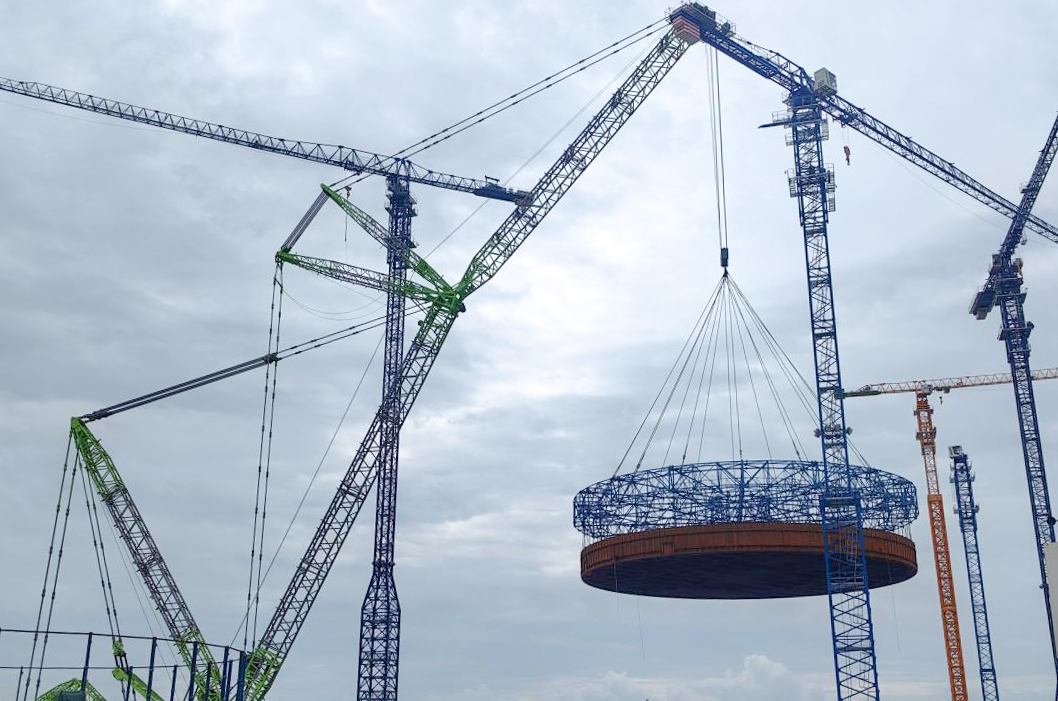
Lifting of Steel Liner Module 1 for Unit 4 of Guangdong Taipingling Nuclear Power Plant Successfully Completed
A key construction milestone was reached at the Guangdong Taipingling nuclear power construction site, where the 2,000-tonne crawler crane of CNNC Machinery Engineering precisely completed the lifting and positioning of Steel Liner Module 1 for Unit 4 of Guangdong Taipingling Nuclear Power Plant. The entire lifting operation lasted 2 hours and 12 minutes, with smooth and orderly lifting, lowering, and slewing movements, and strict control over safety and quality throughout the process, marking the official commencement of main structure construction for the nuclear island reactor building. As the core barrier of the reactor containment, the steel liner module safeguards the nuclear safety defense line, and modular lifting is also a key technical step in the batch construction of Hualong One reactors. The steel liner module lifted this time integrates the base plate in one formed piece, featuring a large diameter, thin shell wall, and relatively low stiffness...
2026-08-04

CGN Dasheng Launches Nondestructive Testing Solutions for Power Batteries to Address New Safety Requirements for Electric Vehicle Batteries
The national mandatory safety standard "Safety Requirements for Traction Batteries for Electric Vehicles" officially takes effect on July 1, 2026, further raising the requirements for power battery safety inspection. In response to the needs for internal defect identification, fault tracing, and in-line production testing, CGN Dasheng Accelerator Technology Co., Ltd. has launched multiple nondestructive testing solutions, utilizing X-ray imaging, industrial CT, and electron beam scanning microfocus X-ray source technologies to provide inspection means for power battery quality control. The internal structure of power batteries is complex, with cells typically composed of multiple layers of materials wound or stacked. During production, subtle defects such as electrode plate wrinkles, metal debris contamination, positive-negative electrode misalignment, and welding porosity can...
2026-08-04
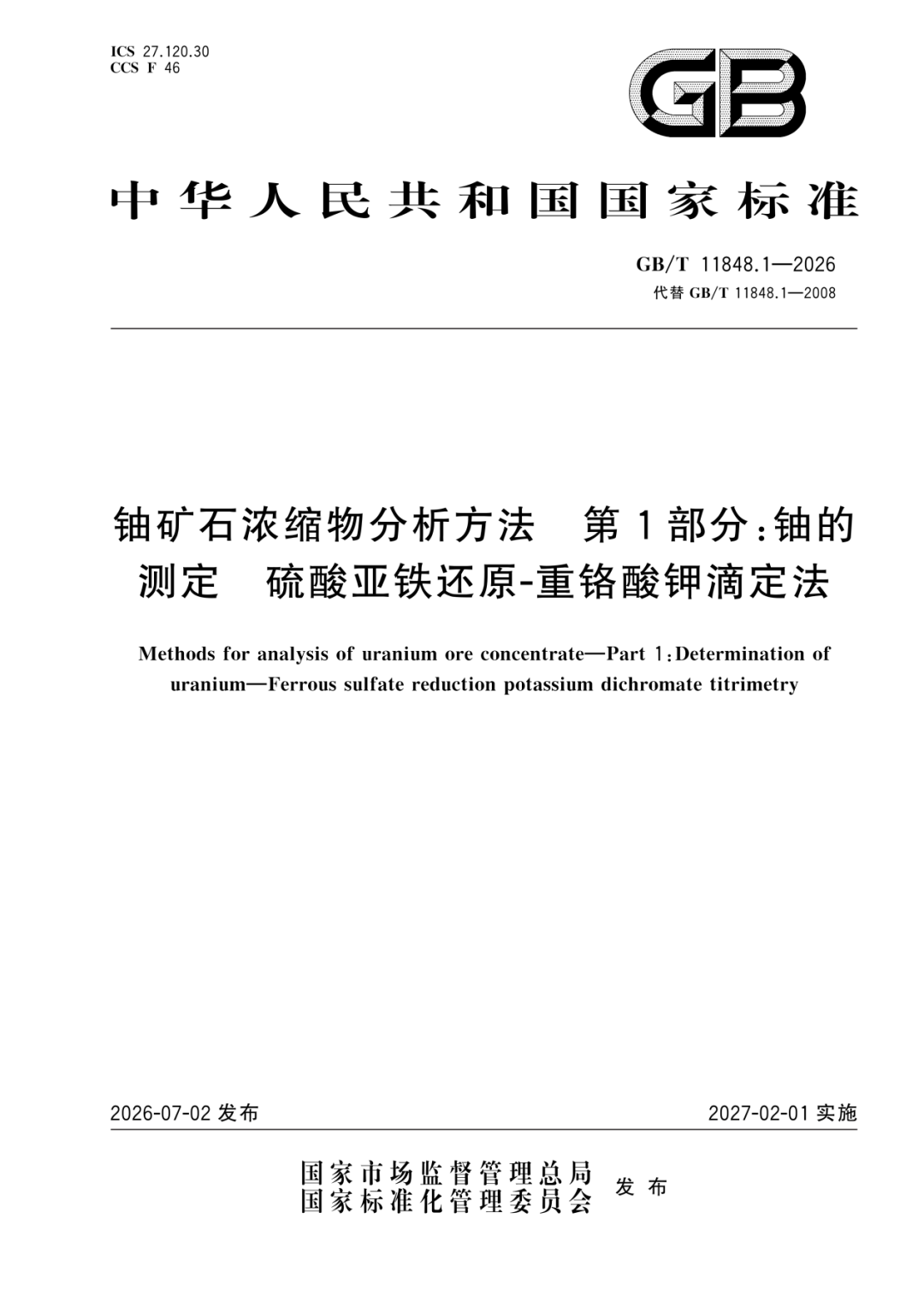
National Standard Compiled by CNNC Mining and Metallurgy Technology Successfully Released
Recently, the national standard "Methods of Analysis of Uranium Ore Concentrate - Part 1: Determination of Uranium - Ferrous Sulfate Reduction - Potassium Dichromate Titration Method" (GB/T 11848.1-2026), compiled by CNNC Mining and Metallurgy Technology Group Co., Ltd. (Beijing Research Institute of Chemical Engineering and Metallurgy, CNNC), was officially released. With this, all 15 national standard methods for "Methods of Analysis of Uranium Ore Concentrate" (GB/T 11848.2-11848.16, implemented in May 2026) led by our company have been fully released. Uranium ore concentrate is an important intermediate product in the nuclear fuel cycle, with its core value lying in the uranium it contains. The determination of uranium content is a crucial link throughout the entire industrial chain from ore to nuclear fuel. This is not merely a simple compositional analysis, but a core step in ensuring economic benefits, product compliance, process safety, and conformity with international regulations. The control of impurity elements plays an important role in the uranium purification and conversion process. The determination of impurity elements is primarily aimed at meeting product control and quality assurance requirements, ensuring downstream process safety, and supporting nuclear safeguards and forensic traceability. The new series of analytical methods is better adapted to modern production processes and detection techniques.
2026-08-03
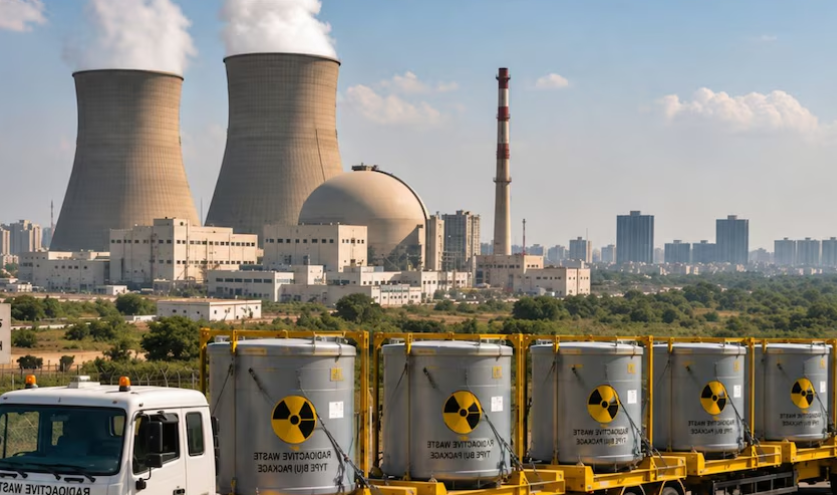
Behind India's Nuclear Power Expansion: Where Does Radioactive Waste Go? Government Details Management Process in Parliament for First Time
India is rapidly advancing its nuclear power expansion, but the safe disposal of radioactive waste is the least-publicized challenge. The government has for the first time detailed in Parliament how it handles hazardous waste. In a written reply, the Department of Atomic Energy disclosed that all nuclear power plants in India generate an average of 0.15 cubic meters (approximately 150 liters) of solid radioactive waste per megawatt (MW) of capacity annually, including waste from operational and decommissioning phases, equivalent to about 1.5 household bathtubs in volume; radioactive waste quantities and disposal records are regularly reported to the Atomic Energy Regulatory Board (AERB). The operation and maintenance of nuclear power plants generate various types of radioactive waste, including spent filter cartridges, protective clothing, tools, equipment, and other items that come into contact with radioactive materials. Waste is categorized into gaseous...
2026-08-03

New Progress in First-Principles Quantum Computing for Nuclear Structure
Recently, the research team at the Institute of Modern Physics, Chinese Academy of Sciences, has made new progress in quantum computing studies of first-principles nuclear structure for multi-fermion systems. The team developed a universal quantum-classical hybrid computing framework capable of calculating Green's functions and spectral functions of nuclear many-body systems. The relevant results were published as a Letter in Physical Review C. First-principles Hamiltonian many-body calculations are a core approach for revealing the laws of strongly correlated quantum systems, widely applied in fields such as quantum chemistry and nuclear physics. However, the Hilbert space of such problems grows exponentially with particle number, posing insurmountable computational resource challenges on classical computers...
2026-08-03

New Progress in Ion Dynamics Regulation in Nanofluidic Memristors by the Institute of Modern Physics, Chinese Academy of Sciences
Water-based nanofluidic ionic devices offer unique advantages in frontier fields such as brain-computer interfaces and biocompatible computing. Recently, the research team from the State Key Laboratory of Heavy Ion Science and Technology at the Institute of Modern Physics, Chinese Academy of Sciences, in collaboration with Lanzhou University, Hebei University of Geosciences, and other partners, successfully achieved stable ionic memristive effects in single-ion-track nanochannels. Through precise regulation, they realized programmable transitions in memristive and synaptic functions, providing a new technological pathway for the development of next-generation low-power neuromorphic computing hardware. The related results were published in the journal *Small* on July 22. Leveraging the Heavy Ion Research Facility in Lanzhou (HIRFL), the researchers...
2026-08-03

Progress and Cost Performance Management of the ITER Project Enhancement
The ITER Organization reported on July 29 that, regarding the construction progress and cost control of the International Thermonuclear Experimental Reactor (ITER), the project team has established a more detailed monthly tracking mechanism, and regularly reports key performance indicators, updated estimates at completion, and milestone trend analyses to the ITER Council. The ITER project is large in scale with complex interfaces; management efforts involve not only overall schedule and budget but also continuous assessment of thousands of activities including design, manufacturing, component installation, commissioning, and operational readiness. For tasks on the critical path, even delays of a few weeks can have cascading effects on multiple construction work packages. To identify...
2026-08-03

The Institute of High Energy Physics of the Chinese Academy of Sciences Successfully Held the Fourth "1+1" Youth Forum on Nuclear and Particle Physics — Frontier Technologies Empowering Nuclear Medicine Diagnosis and Treatment
On July 25, 2026, the fourth "1+1" Youth Forum on Nuclear and Particle Physics (hereinafter referred to as the "1+1 Forum") was successfully held at the Institute of High Energy Physics of the Chinese Academy of Sciences (hereinafter referred to as IHEP). Themed "Frontier Technologies Empowering Nuclear Medicine Diagnosis and Treatment," the forum was organized by the Youth Working Committee of the Beijing Nuclear Society and the IHEP Group of the Youth Innovation Promotion Association of the Chinese Academy of Sciences, co-organized by the Institute of High Energy Physics of the Chinese Academy of Sciences and the School of Nuclear Science and Technology of the University of Chinese Academy of Sciences, and hosted by the R&D Center for Nuclear Technology (Nuclear Detection and Nuclear Imaging) of the China Atomic Energy Authority and the Beijing Engineering Research Center for Radiation Imaging Technology and Equipment. The 1+1 Forum has always adhered to the principle of organically combining demand with technology, academia with science popularization...
2026-08-03

After 25 Years, the Muon Wobble Puzzle Sees Key New Progress in Physics
For 25 years, precise measurements of how muons wobble in a magnetic field have been a major puzzle in particle physics. Early experiments showed a discrepancy between the measured value of the muon's g-factor and theoretical predictions, a difference once seen as a possible hint of unknown particles. Recent new theoretical calculations and experimental analyses have brought a new twist to this puzzle. The muon is a heavier cousin of the electron that precesses like a tiny magnet in a magnetic field. Its extra wobble is quantified by the muon g-2 coefficient. According to quantum theory, known particles and interactions influence this coefficient through fleeting quantum fluctuations, making muon g-2 a key test of the Standard Model...
2026-08-03

German Science and Humanities Council Supports German Participation in the LEGEND-1000 Neutrinoless Double Beta Decay Experiment
On July 27, 2026, the German Science and Humanities Council expressed its support for German participation in the LEGEND-1000 experiment. The project had previously passed scientific evaluation and was deemed significant for a broad research community in the fields of particle physics and nuclear physics. LEGEND-1000 is the next phase of the large-scale enriched germanium neutrinoless double β decay experiment, planned to be constructed by an international collaborative team at the underground laboratory of the Gran Sasso National Laboratory in Italy. German participating institutions include the Max Planck Institute for Nuclear Physics in Heidelberg and the Technical University of Munich, with project leaders being Professor Susanne Mertens and Professor Stefan Schönert, respectively. According to the project...
2026-08-03

Bolivia Advances Legislative Process for Peaceful Nuclear Technology Applications
EL ALTO, Bolivia, July 29 - The Bolivian Nuclear Energy Agency (ABEN) recently held working exchanges with relevant committees of the Plurinational Legislative Assembly to discuss the reactivation of related legislative agendas, focusing on the continued advancement of Bolivia's nuclear energy program and peaceful nuclear technology application projects. René Soria Sausedo, Executive Director of ABEN, stated that as the primary operating entity of Bolivia's nuclear program, ABEN bears the responsibility of driving the implementation of peaceful nuclear technology application projects. These efforts require modern legal instruments to define institutional mandates, technical standards, and the fundamental legal framework for project development. The parliamentary delegation, led by the President of the International Policy and Migration Protection Committee, visited ABEN facilities...
2026-08-03