
Search Results
Keyword:JAPAN

Japan's Chugoku Electric Power swings to loss in FY2026 Q1 as nuclear shutdown raises costs
Japan's Chugoku Electric Power Co. announced its consolidated financial results for the first quarter (April-June) of fiscal year 2026 on July 31. During the reporting period, the company's sales increased 4.4% year-on-year to 343.9 billion yen, up 14.3 billion yen from the same period last year, mainly driven by growth in electricity sales volume. Profit performance, however, came under significant pressure. The company posted an operating loss of 5.3 billion yen, an ordinary loss of 3.2 billion yen, and a net loss of 3.7 billion yen for the first quarter, compared with a net profit of 26.8 billion yen in the same period last year, a year-on-year decrease of 30.5 billion yen. This marks the first time since the first quarter of fiscal year 2022 that the company has recorded simultaneous losses in operating profit, ordinary profit, and net profit over a four-year period. The company stated...
2026-08-02

Japan aims to rebuild up to 5 retired nuclear power plants by the 2040s
The Japanese government held a ministerial meeting on nuclear power on July 31 and decided to rebuild up to 5 retired nuclear power plants by the 2040s. This is the first time since the Fukushima Daiichi nuclear accident that the Japanese government has set a specific numerical target for nuclear plant reconstruction. Kansai Electric Power Company's Mihama Nuclear Power Plant Japanese Prime Minister Takaichi Sanae stated at the meeting that to steadily advance nuclear power investment, the Takaichi cabinet will continue to promote nuclear energy policy. According to the direction set at the meeting, Japan plans to rebuild 2 to 5 nuclear power plants by the 2040s, with a total installed capacity of approximately 2.2 million to 5.5 million kilowatts; by the 2050s, the reconstruction scale will expand to 11 to 14 plants, with a total installed capacity of approximately 12.7 million to 16 million kilowatts. The Japanese government plans to...
2026-08-01

Six radiation monitoring posts in Kumamoto Prefecture, Japan, resumed transmission on the morning of the 30th after being interrupted by power outages caused by the earthquake
Radiation monitoring stations in Kumamoto Prefecture, Japan, have resumed operations after data interruptions caused by the earthquake. On the morning of July 30, data transmission at all monitoring stations returned to normal. The initial cause of the malfunction is believed to be power outages resulting from the earthquake, and the Nuclear Regulation Authority of Japan will conduct further investigations into the matter. A total of six radiation monitoring stations are located in Kumamoto Prefecture, distributed across Kumamoto City, Uto City, and other areas, used for real-time measurement of radiation levels in the environment. Starting around 11 p.m. on July 28, data transmission from these stations was suddenly interrupted, making it impossible to assess local radiation levels. This situation drew significant attention from relevant authorities. According to the Nuclear Regulation Authority of Japan...
2026-07-31

Japan's Fukushima Daiichi Nuclear Power Station launches 22nd release of radioactive wastewater into the ocean, approximately 7,800 tons this time
On the morning of July 30, 2026, Tokyo Electric Power Company (TEPCO) initiated a new round of nuclear-contaminated water discharge into the ocean at the Fukushima Daiichi Nuclear Power Station. This marks the 4th release within 2026 and the 22nd since the discharge plan began in August 2023. According to data released by TEPCO, this discharge is expected to continue until the 17th of next month, with a total volume of approximately 7,800 tons. The total amount of radioactive substance tritium contained therein is as high as approximately 1.3 trillion becquerels. Prior to this, Japan had conducted a total of 21 rounds of radioactive wastewater discharge by the 24th of this month, with a cumulative discharge volume reaching approximately 165,000 tons. This action continues to draw attention and concern from neighboring countries and the international community. This time...
2026-07-31

QST completes first gyrotron 170 GHz microwave output test at ITER site
The National Institutes for Quantum Science and Technology (QST) of Japan announced on July 31 that it has completed the integration and operational testing of the first gyrotron system at the International Thermonuclear Experimental Reactor (ITER) site in southern France, successfully producing 170 GHz microwave output. This system is used for ITER plasma generation and heating, and is one of the key devices for ITER's plan to commence operations in 2034. The core equipment of this test is the gyrotron, a high-power microwave source. Gyrotron operation requires the coordinated work of peripheral equipment such as power supplies, superconducting coils, and cooling systems. QST previously completed performance testing of eight ITER gyrotron systems at the gyrotron test facility of the Naka Fusion Institute in Japan, and transported components including gyrotrons, superconducting coils, and quasi-optical matching units to the ITER site. Over the past three years, QST has advanced system installation, commissioning, and operational preparation at the site.
2026-07-31

Russian researchers detect anomalous signs in bottomonium states using Belle II experiment data
The Budker Institute of Nuclear Physics of the Siberian Branch of the Russian Academy of Sciences recently announced that Russian researchers have detected anomalous phenomena in the analysis of data from the international Belle II experiment, indicating that the structure of certain excited states of bottomonium may be more complex than predicted by traditional models. Bottomonium is a class of unstable heavy particles composed of a bottom quark and an anti-bottom quark. Yevgeny Kovalenko, a young researcher at the Budker Institute of Nuclear Physics of the Siberian Branch of the Russian Academy of Sciences, stated that analysis of Belle II experiment data suggests that certain excited states of bottomonium may contain lighter quark components. In other words, these particles in specific states may not simply be plain bottom quark–anti-bottom quark combinations.
2026-07-31

South Korea Confirms Operating Nuclear Power Units Unaffected by Strong Earthquake in Kyushu, Japan
Following the strong earthquake in the Kyushu region of Japan, related aftershock signals have been detected in southern South Korea. The Nuclear Safety and Security Commission (NSSC) of South Korea stated that inspections confirmed all operating nuclear power units within the country remain unaffected. The NSSC noted that after the earthquake, inspections were conducted on all 27 operating nuclear power units, including the Kori Nuclear Power Plant in Busan and the Wolseong Nuclear Power Plant in Gyeongju, with no significant abnormalities or safety issues found. Korea Hydro & Nuclear Power (KHNP) also stated that no reports of damage to nuclear facilities have been received so far. The NSSC will continue to monitor the operational status of nuclear power plants to respond to potential subsequent aftershocks....
2026-07-31

Japan Atomic Industrial Forum Chairman: Overseas SMR Projects Help Sustain Supply Chain, but Japan Still Needs to Build New Nuclear Plants
Hideki Masui, Chairman of the Japan Atomic Industrial Forum (JAIF), stated on May 31 that Japanese companies are playing a significant role in global small modular reactor (SMR) projects through design and equipment supply, but the long-term maintenance and development of Japan's nuclear technology base ultimately requires the construction of new nuclear power plants domestically. At a regular press conference, Masui reviewed international developments in the SMR field. He noted that approximately 30 countries currently use nuclear energy, and about 20 countries are studying the deployment of SMRs in some form. Projects involving Japanese companies include GE Vernova Hitachi Nuclear Energy's BWRX-300 and NuScale Power's VOYGR SMR, whi...
2026-06-06

Masayoshi Son: Nuclear Fusion Could Become Key to Powering Future AI Data Centers
SoftBank Group founder Masayoshi Son said at the SoftBank World annual event in Tokyo on July 14 that as electricity demand from AI data centers continues to rise, nuclear fusion technology is expected to become one of the most realistic power solutions in the near future. Son believes that most of the current electricity demand from data centers will still be met by natural gas, but this landscape could change over the next 15 years. He predicted that by 2040, global data center capacity demand will reach 3 terawatts, with nuclear fusion playing a significant role. He said at the event that fusion will become a major source of a cheaper, cleaner, and safer new form of energy on Earth, and asked rhetorically: Now...
2026-07-15

Third fuel debris retrieval test at Fukushima Daiichi Unit 2 postponed due to robotic arm malfunction
The robot used by Tokyo Electric Power Company (TEPCO) for the third experimental fuel debris retrieval at Fukushima Daiichi Nuclear Power Station Unit 2 malfunctioned during an on-site operational test, forcing the cancellation of the plan originally scheduled to start after July 2026 if all went well. The company stated it will reassess the relevant procedures. The malfunction occurred in part of the large robotic arm equipment used to collect fuel debris. During an operational test in the reactor building of Unit 2, TEPCO found an abnormality in one of the motors driving the robotic arm, causing the brake to fail to release and the arm to be unable to extend. The company is currently studying the replacement of the faulty motor. The third experimental retrieval plan was to use a large robotic arm...
2026-07-31

Restart of Tomari Nuclear Power Plant Unit 3 Delayed to After End of 2027
Hokkaido Electric Power Co. announced on July 30 that the restart of Unit 3 at the Tomari Nuclear Power Plant will be significantly delayed compared to earlier expectations, with the earliest possible date being the end of 2027 or later. Previously, the company had set a target of restarting as early as possible within 2027, but due to delays in the seawall construction project and the fact that the Nuclear Regulation Authority (NRA) has not yet completed its review of the relevant design and construction plans, the timeline for the unit's return to operation remains uncertain. Hokkaido Electric Power President Susumu Saito stated at a press conference that the seawall at the Tomari plant was originally scheduled for completion in the spring of 2027, but is now expected to be finished by mid-August 2027 due to additional work such as seismic reinforcement of the wharf and liquefaction countermeasures...
2026-07-31

Tokamak Energy's ST40 device new gyrotron completes site acceptance test
Tokamak Energy disclosed on July 29 that the new gyrotron planned for its high-field spherical tokamak device ST40 has completed site acceptance testing. The equipment, which will serve as the core component of the radio frequency heating system, has undergone key performance verification before installation on ST40. During this test, the gyrotron achieved stable 1 MW power operation at both 104 GHz and 137 GHz frequencies, with pulse lengths up to 2 seconds. The test content included repeatability, modulation capability, power control, and mode purity, and the results demonstrated that the equipment can meet the requirements for sustained performance output in relevant fusion experiments. The gyrotron was built by Kyoto Fusioneering...
2026-07-30
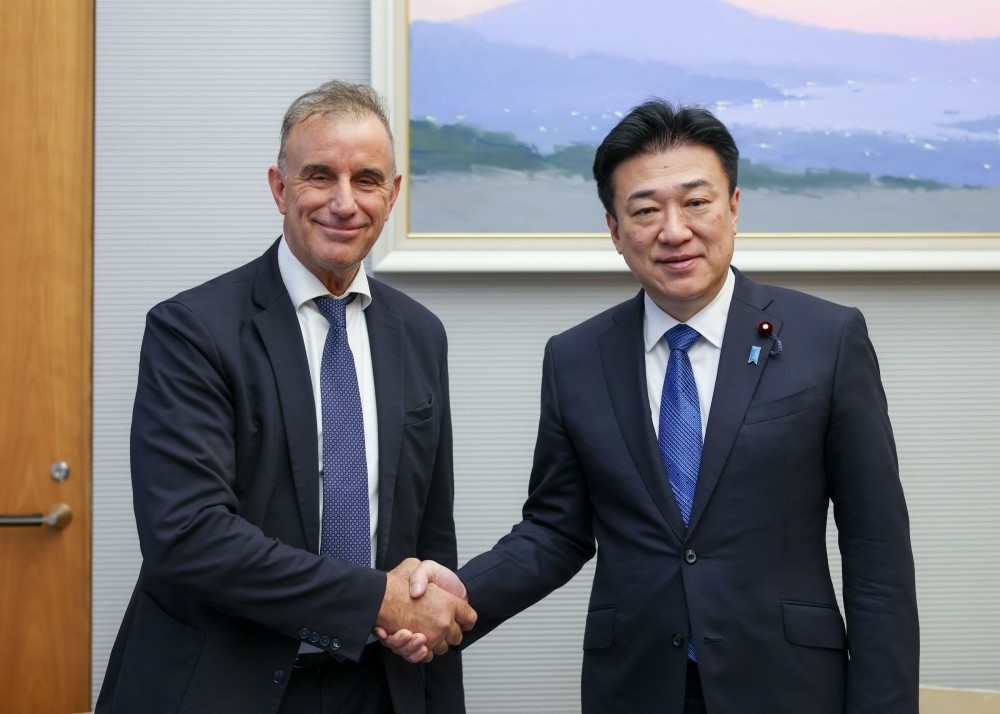
Japan's Chief Cabinet Secretary Meets ITER Organization Director-General
Starting at 4:50 p.m. on July 29, Japan's Chief Cabinet Secretary Yoshimasa Hayashi met with Pietro Barabaschi, Director-General of the International Thermonuclear Experimental Reactor (ITER) Organization, who was visiting Japan. The meeting lasted approximately 15 minutes. (Photo source: Japan Cabinet Public Affairs Office) Hayashi welcomed Barabaschi's visit to Japan. He stated that fusion energy has been listed as one of the 17 strategic areas in Japan's growth strategy. Japan looks forward to progress in the ITER project and believes it will play a significant role in advancing the realization of fusion energy and enhancing energy security. Hayashi...
2026-07-30

Japan Nuclear Fuel Company Says It Will Propose New Schedule for Rokkasho Reprocessing Plant as Soon as Possible
Naohiro Masuda, President of Japan Nuclear Fuel Company (JNFL), stated at a regular press conference on July 29 that the spent nuclear fuel reprocessing plant in Rokkasho Village, Aomori Prefecture, may be difficult to complete within the current fiscal year. The company will propose a new overall schedule as soon as possible after continuing consultations with regulatory authorities on the treatment of liquid waste within the facility. Masuda said that earlier this month, when an official from the Agency for Natural Resources and Energy of the Ministry of Economy, Trade and Industry met with Aomori Governor Soichiro Miyashita, Miyashita had informed the official that completing construction of the reprocessing plant within the current fiscal year would be challenging. Masuda stated that the company needs to make every effort to avoid the risk of schedule delays becoming a reality, and will manage the project construction progress from multiple aspects...
2026-07-30

Japan's Nuclear Regulation Authority to Revise Seismic Review Guidelines for Nuclear Power Plants
Following the exposure of Chubu Electric Power Co., Inc.'s alleged tampering with data related to earthquake assumptions at the Hamaoka Nuclear Power Plant in Shizuoka Prefecture, Japan's Nuclear Regulation Authority (NRA) has decided to revise certain seismic review guidelines for nuclear power plants to strengthen prevention of similar misconduct. At a regular meeting held on July 29, the NRA decided to proceed with revisions to the guidelines concerning seismic assumption reviews. Previously, the review process primarily focused on the calculation results submitted by nuclear power plant operators. The revision will extend the scope of verification to include the calculation process and the data used therein, in order to prevent companies from intentionally selecting, adjusting, or manipulating data.
2026-07-30