
Search Results
Keyword:expansion

South Korea's Nuclear Expansion Faces Fuel Supply Pressure as Enriched Uranium Costs Surge Nearly Sixfold in Seven Years
Against the backdrop of accelerating global nuclear power construction and surging electricity demand from AI data centers, the nuclear fuel supply chain is facing new tensions. Due to limited uranium enrichment capacity and sanctions affecting Russian-related supplies, international uranium enrichment prices have risen sharply over the past seven years. South Korea's nuclear expansion plans are consequently facing fuel procurement pressure, with industry experts concerned that if mid- to long-term nuclear fuel security proves insufficient, newly built nuclear units could face operational risks in the future. Korea Hydro & Nuclear Power (KHNP) recently disclosed that South Korea's domestic annual enriched uranium consumption is expected to increase from approximately 460 tons currently to about 540 tons next year. The rising demand mainly stems from the overlap between life-extension operations of some older nuclear units and the commissioning of new units...
2026-08-18

Rosatom Says Paks Nuclear Power Plant Expansion Project Progressing as Planned
Alexey Likhachev, Director General of Rosatom, stated that the construction of the Paks nuclear power plant expansion project in Hungary, with Russian participation, is progressing well, and Rosatom is carrying out related work in accordance with the plan agreed upon with the Hungarian owner. Likhachev noted that Russia is fully organizing equipment production for the two new units at the Paks nuclear power plant. Currently, enterprises under Rosatom have initiated manufacturing work related to the reactors for both units. Among these, the forging blanks for the reactor of Unit 5 at the Paks nuclear power plant have been completed, and the shell assembly stage will begin shortly. He also stated that the casting of the reactor blank for Unit 6 at the Paks nuclear power plant is progressing as planned.
2026-08-14

Polar Crane of Unit 1 of Shidao Bay Nuclear Power Expansion Phase I Project Officially Available
On August 12, the load test of the polar crane for Unit 1 of the Expansion Phase I Project was successfully completed, with all performance indicators fully meeting design requirements, marking that the polar crane is officially ready for use and creating favorable conditions for subsequent key tasks such as the introduction and positioning of main equipment in the nuclear island. The polar crane is the core lifting equipment in the reactor building, undertaking critical lifting and handling tasks throughout the entire lifecycle, including heavy equipment hoisting during the construction phase, refueling during shutdown and equipment maintenance during the operation phase, and equipment dismantling during the decommissioning phase. Its operational stability and reliability are directly related to the safety and quality of nuclear island installation. The success of this load test fully verified that all performance indicators of the equipment completely meet the standards for safe and reliable use...
2026-08-13
Urenco in Almelo, Netherlands accelerates expansion, ninth centrifuge hall enters planning
Urenco in Almelo, the Netherlands, is continuing its large-scale expansion. Before a new large facility has even been completed, the company has already begun advancing its next expansion project, with a ninth production hall housing thousands of centrifuges now in the preparatory stage. This signals a clear acceleration in the pace of the company's uranium enrichment capacity expansion. Urenco's core business is supplying fuel for nuclear power plants, namely enriching uranium through centrifuges. In recent years, tight global energy supply, fluctuating natural gas prices, and heightened energy security concerns have brought nuclear energy back into focus for many countries. As demand for nuclear power rises, the importance of the nuclear fuel supply chain has also grown, and Urenco...
2026-08-12

India's Nuclear Power Expansion Drives Up Uranium Demand, Annual Demand Could Reach 5,400 Tonnes
India is accelerating its nuclear energy development program, with uranium resource demand rising correspondingly. According to estimates by the Indian Parliament's Committee on Public Undertakings in its follow-up report on NPCIL performance rectification, India will require approximately 5,400 tonnes of uranium annually in the future as nuclear power projects expand. This figure reflects the urgency of India's energy structure adjustment and indicates the rising status of nuclear power in its long-term electricity planning. Currently, domestic uranium production in India can only meet about 30% of demand, with the remainder relying on imports, primarily from countries including Kazakhstan, Russia, Uzbekistan, and Canada. The Parliamentary Committee therefore emphasized...
2026-08-10

Belarus Plans Nuclear Expansion: BelAES Unit 3 and Second NPP in Mogilev Region to Advance in Parallel
Belarusian Energy Minister Denis Moroz recently stated that nuclear energy has become a strategic energy direction for Belarus, bearing on national energy security, economic growth, and technological sovereignty. Since the Belarusian Nuclear Power Plant was commissioned, it has helped the country reduce its dependence on imported natural gas, cumulatively replacing approximately 14.5 billion cubic meters of natural gas and saving over $600 million in budget funds. After assessing the multiplier effect of nuclear power on the economy, Belarus has decided to continue advancing its nuclear energy development. Moroz stated that the country has made a principled decision: on the one hand, to build a third unit at the Belarusian Nuclear Power Plant (BelAES) in Ostrovets, and on the other hand, to simultaneously study the plan for constructing a second nuclear power plant.
2026-08-09

Dark Energy Survey Releases Six-Year Results: Data from 669 Million Galaxies Helps Constrain Cosmic Accelerated Expansion
On August 4, the Dark Energy Survey (DES) project released its six-year findings on dark energy detection. The project compiled 18 related papers, based on nearly 300,000 astronomical images captured between 2013 and 2019, recording information on 669 million galaxies, thousands of galaxy clusters, and more than 3,000 supernovae to study the accelerated expansion of the universe and the evolution of cosmic structure. To carry out DES, Fermi National Accelerator Laboratory built an extremely sensitive 570-megapixel digital camera, DECam, which was installed on the Blanco 4-meter telescope at the National Science Foundation's Cerro Tololo Inter-American Observatory in the Chilean Andes. (Image courtesy of Reidar Hahn/Fermi National Acceler...
2026-08-06
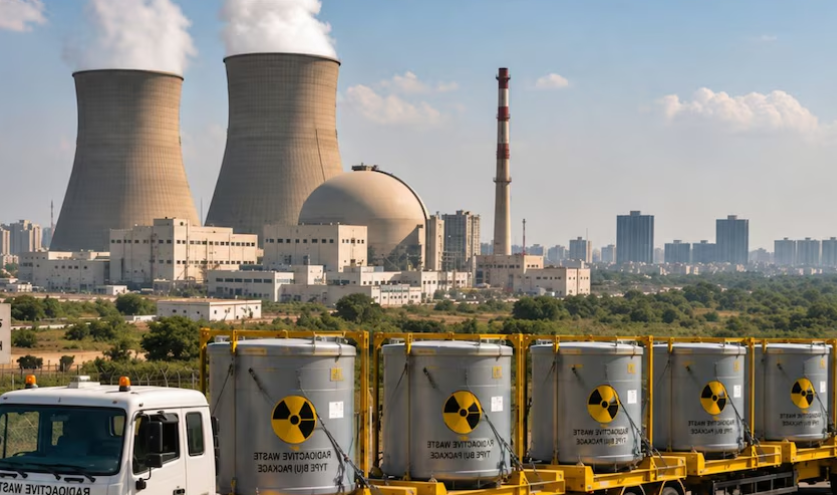
Behind India's Nuclear Power Expansion: Where Does Radioactive Waste Go? Government Details Management Process in Parliament for First Time
India is rapidly advancing its nuclear power expansion, but the safe disposal of radioactive waste is the least-publicized challenge. The government has for the first time detailed in Parliament how it handles hazardous waste. In a written reply, the Department of Atomic Energy disclosed that all nuclear power plants in India generate an average of 0.15 cubic meters (approximately 150 liters) of solid radioactive waste per megawatt (MW) of capacity annually, including waste from operational and decommissioning phases, equivalent to about 1.5 household bathtubs in volume; radioactive waste quantities and disposal records are regularly reported to the Atomic Energy Regulatory Board (AERB). The operation and maintenance of nuclear power plants generate various types of radioactive waste, including spent filter cartridges, protective clothing, tools, equipment, and other items that come into contact with radioactive materials. Waste is categorized into gaseous...
2026-08-03