
 Registration
REGISTER FOR THE CONFERENCE
Registration
REGISTER FOR THE CONFERENCE
 Apply to Exhibit
APPLICATION FOR EXHIBITION
Apply to Exhibit
APPLICATION FOR EXHIBITION
 Sponsorship
SPONSORSHIP APPLICATION
Sponsorship
SPONSORSHIP APPLICATION

Germany Launches Fusion Milestone Program: Plans to Invest €2.5 Billion to Support Fusion Companies Toward Commercialization
On October 7, 2026, the German Federal Agency for Breakthrough Innovation (SPRIND), on behalf of the German Federal Ministry of Research, Technology and Space (BMFTR), officially launched the Fusion Milestone Program. The program is an important component of Germany's High-Tech Agenda (HTAD), aiming to promote fusion startups and young companies from technology R&D toward demonstration power plant construction through funding support linked to technological progress and commercialization outcomes, further shortening the distance from laboratory research to commercial application of nuclear fusion. According to the program arrangements, the German government will provide funding support through the Special Fund for Infrastructure and Climate Neutrality (SVIK), with plans to invest...
2026-10-09

Zhuanghe Nuclear Power convenes the fourth meeting of the Safety Committee in 2026 and the work safety situation analysis meeting
2026-10-09

Construction Management Practice of Unbonded Prestressed Tendons in the Containment of the Reactor Building
2026-10-09

Concrete pouring for the turbine pedestal of the conventional island of Guangdong Taipingling Unit 3 completed successfully
2026-10-09
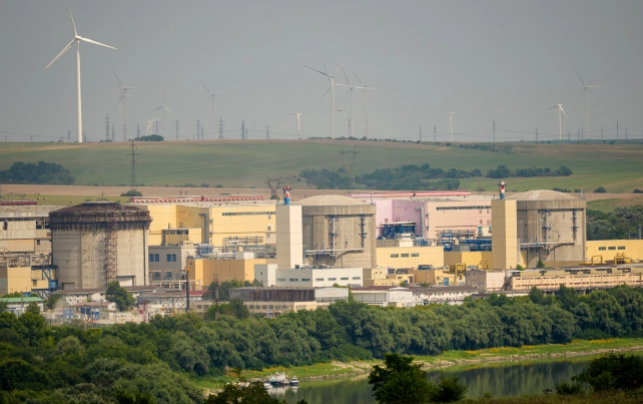
Romania's National Nuclear Power Company Plans to Borrow EUR 800 Million from the European Investment Bank: Full Speed Ahead on the Refurbishment of Cernavodă NPP Unit 1
2026-10-08

Guangxi Nuclear Power Smart Fire Protection Pilot Project Officially Applied
2026-10-08

Preparations Underway for First Nuclear Fuel Loading at San'ao Nuclear Power Project Unit 2
2026-10-08

Large-Scale Nuclear Emergency Exercise Held at Russia's Beloyarsk NPP: Simulating Response to Concurrent Dual-Reactor Accident
2026-10-08

U.S. Department of Energy Plans to Provide Vistra with $4.2 Billion Conditional Loan to Support Power Uprates and Life Extensions at Operating Nuclear Plants: Safeguarding Nearly 4 GW of Baseload Power to Meet Surging Electricity Demand from AI Data Centers
2026-10-08

GE HealthCare, the Chicago-based medical imaging and radiodiagnostics giant, has announced that it has entered into a definitive acquisition agreement to acquire radiopharmaceutical company Sofie Biosciences in an all-cash deal valued at $945 million from private equity firm Trilantic North America. The transaction is expected to complete all regulatory approvals and closing procedures by July 2027, and is expected to be accretive to GE HealthCare's revenue growth and adjusted earnings in the first full fiscal year following closing. Founded in 2008 and headquartered in Dulles, Virginia, Sofie Biosciences has built a broad radiopharmaceutical production and distribution network across the United States...
2026-10-08
Recently, the press office of TU Wien (Vienna University of Technology) announced that a team of scientists from Austria, Germany, and the Czech Republic has successfully developed the world's first nuclear clock based on the thorium-229 (chemical symbol ²²⁹Th) atomic nucleus. This nuclear clock possesses extremely high interference resistance and is capable of operating in a fully autonomous mode without external stabilization. The research team stated that, compared with traditional atomic clocks that operate using entire atoms, timekeeping using atomic nuclei can theoretically achieve higher measurement precision. Two years ago, they successfully controlled the transition process of the thorium-229 atomic nucleus for the first time, but to achieve extremely high-precision timekeeping, it was still necessary to solve the nuclear clock...
2026-10-08
A research team from the Joint Institute for High Temperatures of the Russian Academy of Sciences (JIHT RAS / ОИВТ РАН) has achieved an important physics advance in the study of extreme high-temperature and high-pressure states: researchers have discovered a previously undescribed phase transition in cesium (Cesium) under dense plasma conditions, accompanied by a dramatic jump-like change in electrical conductivity. The study focuses on the microscopic physical behavior of matter at temperatures from 500 to 20,000 Kelvin (K) and pressures ranging from about 1 hectopascal (hPa) to several terapascals (TPa). Under such severe extreme conditions, interatomic distances are greatly compressed, matter undergoes multiple deep ionizations, and the traditional criteria for distinguishing solid, liquid, and gas states can no longer...
2026-10-08
The 2026 Nobel Prize in Physics was awarded for a major scientific discovery in the field of astrophysical high-energy neutrino detection. The key engineering foundation that made this historic breakthrough possible is a giant scientific facility located near the South Pole——the IceCube Neutrino Observatory. The facility uses nearly 1 cubic kilometer of highly transparent deep Antarctic ice as a natural detection medium, and densely arrays thousands of digital optical modules deep within the ice. Genrikh Scheibler, senior researcher and Candidate of Physical and Mathematical Sciences at the Institute of Semiconductor Physics of the Siberian Branch of the Russian Academy of Sciences (ISP SB RAS), has...
2026-10-08
From 5 to 9 October 2026, the International Symposium on Standards, Applications and Quality Assurance (IDOS 2026), hosted by the International Atomic Energy Agency (IAEA), was held at IAEA Headquarters in Vienna, Austria. More than 500 medical physicists, radiation metrology experts and researchers from 120 countries around the world gathered to discuss precision measurement of radiation doses in radiotherapy, medical imaging and nuclear medicine. With the rapid evolution of radiotherapy technologies, radionuclide therapy and interventional radiology, ionizing radiation in the diagnosis and treatment of malignant tumors and major diseases...
2026-10-08
On the occasion of its 75th anniversary, the Princeton Plasma Physics Laboratory (PPPL), under the U.S. Department of Energy (DOE), hosted the second Adopting Sustainable Partnerships for Innovative Research Ecosystem (ASPIRE) international workshop in the fall of 2026. The workshop was organized by the laboratory's Applied Materials and Sustainability Sciences Directorate and brought together scholars from the University of Osaka in Japan and the Ulsan National Institute of Science and Technology (UNIST) in South Korea, as well as researchers from PPPL, to focus on...
2026-10-08
In October 2026, the North China Nuclear and Radiation Safety Supervision Station of the Ministry of Ecology and Environment (hereinafter referred to as the North China Supervision Station) officially organized the 2026 North China Regional Radiation Safety Regulatory Experience Exchange Activity in Shijiazhuang City, Hebei Province, aiming to further deepen the cross-regional collaborative regulatory mechanism for nuclear and radiation safety. Relevant officials from the Nuclear Facility Safety Regulation Department and the Radiation Source Safety Regulation Department of the Ministry of Ecology and Environment made special trips to the site to provide guidance, conducted in-depth exchanges with frontline regulatory representatives from North China and surrounding key provinces, and put forward clear guidance on current and future regulatory directions. During the exchange activity, representatives from Beijing Municipality, Tianjin Municipality, Hebei Province, Shanxi Province, Inner Mongolia Autonomous Region, Shandong...
2026-10-08


