
Search Results
Keyword:research

South Korea's HD Hyundai Deepens Marine SMR Layout: Joint Industry-University-Research Initiative Establishes Demonstration Center to Accelerate Commercialization Validation of Marine SMRs
South Korean shipbuilding giant HD Hyundai is comprehensively accelerating the commercialization process of Small Modular Reactors (SMRs). The company recently joined hands with South Korea's nuclear energy industry, academia, and authoritative classification societies to sign a multi-party cooperation agreement, announcing the formal establishment of the SMR Marine Technology Demonstration Center, aimed at deeply integrating the construction capabilities of shipbuilding engineering with the cutting-edge research strengths of the nuclear industry and universities, creating a core catalyst for the commercial deployment of marine nuclear power. The demonstration center brings together a total of 12 industry-university-research units, including the Korean Register (KR), key nuclear energy institutions, and multiple major South Korean universities....
2026-10-08

International Researchers Successfully Develop the First Autonomous Thorium-229 "Nuclear Clock": Featuring Ultra-Strong Interference Resistance and a Fully Autonomous Closed-Loop Stable Operation Mechanism
Recently, the press office of TU Wien (Vienna University of Technology) announced that a team of scientists from Austria, Germany, and the Czech Republic has successfully developed the world's first nuclear clock based on the thorium-229 (chemical symbol ²²⁹Th) atomic nucleus. This nuclear clock possesses extremely high interference resistance and is capable of operating in a fully autonomous mode without external stabilization. The research team stated that, compared with traditional atomic clocks that operate using entire atoms, timekeeping using atomic nuclei can theoretically achieve higher measurement precision. Two years ago, they successfully controlled the transition process of the thorium-229 atomic nucleus for the first time, but to achieve extremely high-precision timekeeping, it was still necessary to solve the nuclear clock...
2026-10-08

German Research Team Completes First Phase Analysis of Chernobyl "Hot Particles": Nuclear Fuel Crystal Structure Still Exhibits Unexpectedly High Chemical Stability After 40 Years
Nearly 40 years after the 1986 Chernobyl Nuclear Power Plant accident, a research team from Leibniz University Hannover and Helmholtz-Zentrum Dresden-Rossendorf (HZDR) in Germany has completed the world's first synchrotron radiation X-ray-based precision crystal phase analysis of 6 micron-sized highly radioactive fragments (commonly known in the industry as Hot Particles) ejected from the destroyed reactor. The related breakthrough research findings have been officially published in the top-tier journal in environmental and radioecology, the Journal of Hazardous Materials.
2026-10-07

Experts from 18 Countries Discuss Research Planning for Russia's MBIR Fast Reactor International Research Center: Focusing on Closed Fuel Cycle and Mega-Science Engineering Synergy
At the Institute of Nuclear Physics of the Academy of Sciences of the Republic of Uzbekistan (INP AS RUz), the third meeting of the Advisory Council of the International Research Center (IRC MBIR), established on the basis of the Multi-purpose Fast Neutron Research Reactor (MBIR), was officially convened. The meeting attracted more than 150...
2026-10-03

Chest CT Can Measure Bone Density and Warn of Brain Aging Risk: Latest Research Reveals Link Between Skeletal and Cognitive Decline
Chest computed tomography (CT), routinely used to screen for lung lesions, may hold important clues for assessing brain health. A research team from Johns Hopkins University in the United States explored approaches to using existing chest imaging to assess bone health and link it to brain aging, with the related findings published in September 2026 in the authoritative journal Radiology. The study showed that subjects with lower thoracic vertebral bone density experienced faster cognitive decline during subsequent follow-up, and specific white matter microstructural changes also showed associated degeneration. Chest CT is widely used in lung cancer screening and pulmonary nodule follow-up...
2026-09-30

MOST Sets the Pathway for Hard-Core Science and Technology Breakthroughs in the "15th Five-Year Plan": Comprehensive and Systematic Deployment of Major Basic Research on Controlled Nuclear Fusion to Solidify the Foundation of Future Strategic Energy
At the series-themed press conference on "Getting Off to a Good Start in the '15th Five-Year Plan'" held by the State Council Information Office, the Ministry of Science and Technology officially released the top-level design and core breakthrough roadmap for building a science and technology powerhouse over the next five years. When outlining the layout for major science and technology breakthroughs and original innovation, Minister of Science and Technology Yin Hejun explicitly emphasized that, in strengthening the strategic depth of basic research, China will closely anchor itself to the frontiers of the global energy revolution and, centering on underlying scientific bottlenecks in key fields such as energy and materials, comprehensively and systematically deploy major basic research tasks including controlled nuclear fusion (Controlled Nuclear Fusion), so as to seize the future...
2026-09-30
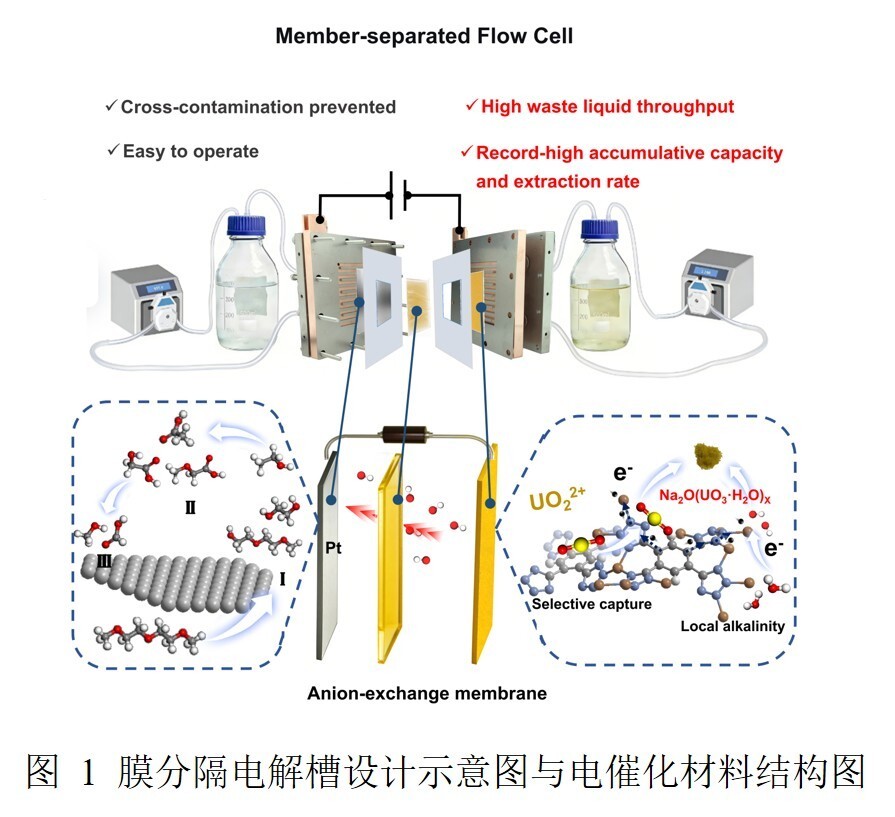
Shanghai Institute of Applied Physics Makes Important Progress in Electrolyzer Design and Electrocatalytic Materials Research
Recently, the National Key Laboratory of Thorium-based Nuclear Fission Energy at the Shanghai Institute of Applied Physics, Chinese Academy of Sciences, has made important progress in the fields of membrane-divided electrolyzer design and electrocatalytic materials. Researchers combined electrolyzer reactor design with electrocatalytic material innovation to develop an anion exchange membrane-divided H-type electrolysis system based on nonporous metal-organic framework (MOFs) materials, achieving efficient electrochemical recovery of uranium resources and complete degradation of organic ether solvents in uranium-containing organic ether wastewater. The related results, titled "Nonporous Metal-Organic Framework Enables Record-High Uranium Extraction and Complete Diglyme Degra...
2026-09-30

State Nuclear Electric Power Planning Design & Research Institute Co., Ltd. convened the first Party Committee (enlarged) meeting of 2026 and the second meeting of the 2026 Safety Production and Emergency Management Committee
On September 28, State Nuclear Electric Power Planning Design & Research Institute Co., Ltd. convened the first Party Committee (enlarged) meeting of 2026 and the second meeting of the 2026 Safety Production and Emergency Management Committee. Guided by Xi Jinping Thought on Socialism with Chinese Characteristics for a New Era, the meeting thoroughly studied and implemented Xi Jinping Thought on Ecological Civilization and General Secretary Xi Jinping's important instructions and directives on safety production, fully implemented the relevant work requirements of the Group Company's Safety Production Deployment Enhancement and Third Quarter Safety Risk Control Meeting, comprehensively reviewed the work of the first three quarters, scientifically assessed the current safety development situation, and arranged and deployed key tasks for safety production and ecological environmental protection in the next stage. Wang Chengli, Secretary of the Company's Party Committee, Chairman, and Director of the Safety Committee...
2026-09-30

Argonne National Laboratory Achieves Latest Research Progress in Advanced Reactor Passive Safety, Revealing Flow Characteristics of Reactor Cavity Cooling System Using NSTF Facility
A research team at Argonne National Laboratory, under the U.S. Department of Energy (DOE), has achieved the latest research progress on passive shutdown decay heat removal mechanisms for next-generation advanced nuclear reactors. Under unplanned reactor shutdown or sudden emergency accident conditions, nuclear fuel continues to release decay heat. Ensuring continuous and reliable heat removal under complete power loss and without manual intervention is a core issue in the inherent safety design of Generation IV advanced reactors. The Argonne research team recently focused on the transient thermal-hydraulic response characteristics of key passive heat removal systems under realistic dynamic decay heat curves. This...
2026-09-30

Standard Technical Specifications for Passive Nuclear Power Plants, Chiefly Compiled Under the Leadership of Shanghai Nuclear Engineering Research and Design Institute, Officially Released
Recently, the National Nuclear Safety Administration officially released the Standard Technical Specifications for Passive Nuclear Power Plants and its explanatory document, chiefly compiled under the leadership of Shanghai Nuclear Engineering Research and Design Institute, aiming to promote the standardization and normalization of technical specifications for passive nuclear power plants, continuously improve the nuclear safety supervision and management system, and further enhance the operational safety level of China's nuclear power plants. Based on the framework and format, screening criteria, and other foundations for technical specifications established by the Special Working Group on Technical Specification Optimization of the National Nuclear Safety Administration, Shanghai Nuclear Engineering Research and Design Institute, targeting the passive design characteristics of AP and CAP series nuclear power plants and fully incorporating the operating experience and safety regulatory practices of China's passive nuclear power plants, completed the compilation of China's first standard technical specifications and explanatory document for passive nuclear power plants...
2026-09-30

KAERI and IAEA Jointly Hold Research Reactor Ageing Management Training Workshop
On September 28, SPIC's first fully independent full-scope simulator and related independent technologies were released in Beijing, marking that State Power Investment Corporation (SPIC) has mastered complete full-scope simulator R&D and supply capabilities. A full-scope simulator is like a mirror of a nuclear power plant; operators performing control actions in the full-scope simulator can obtain realistic feedback in real time. With the help of this digital nuclear power plant that poses no nuclear accident hazard, operators repeatedly hone their daily operation control and accident handling skills, becoming professionals who safeguard the safe and efficient operation of real nuclear power plants. To ensure the training quality of main control room operators at nuclear power plants, the Central Research Institute of SPIC took the lead, together with SNERDI, SNST...
2026-09-28

Kuwait Institute for Scientific Research Joins Arab Atomic Energy Agency
Recently, the Kuwait Institute for Scientific Research (KISR) was approved to join the Arab Atomic Energy Agency (AAEA) to strengthen Kuwait's cooperation with Arab and international institutions in the peaceful uses of nuclear energy. Dr. Habiba Al-Manea, KISR's National Liaison Officer to the International Atomic Energy Agency (IAEA) and member of the AAEA Executive Council, told the Kuwait News Agency (KUNA) that this membership will strengthen technical and scientific cooperation, promote the exchange of expertise, and help develop Kuwait's national capabilities in the peaceful applications of nuclear energy.
2026-09-29

Breakthrough in High-Energy Nuclear Physics Research: Chinese Research Team Leverages CERN's Large Hadron Collider to Reveal How Nuclear Geometry Influences Matter Flow
Relying on the A Large Ion Collider Experiment (ALICE) at the Large Hadron Collider (LHC), the research team led by Professor Li Xiaomei at the National Key Laboratory of Nuclear Data, China Institute of Atomic Energy (CIAE), in international collaboration with the team led by Professor Zhou You at the Niels Bohr Institute, University of Copenhagen, Denmark, conducted research. The joint team studied the Oxygen-16 (Oxygen-16, $^{16}\text{O}$) and Neon-20 (Neon-20, $^{20}\text{Ne}$) light-nucleus collision system and achieved important progress regarding collective flow phenomena dominated by nuclear structure, confirming that the spatial geometric configuration of atomic nuclei can directly regulate the laws of matter flow in high-energy nuclear collisions, providing key experimental constraints for improving relativistic heavy-ion collision theory and resolving microscopic nuclear structure.
2026-09-24
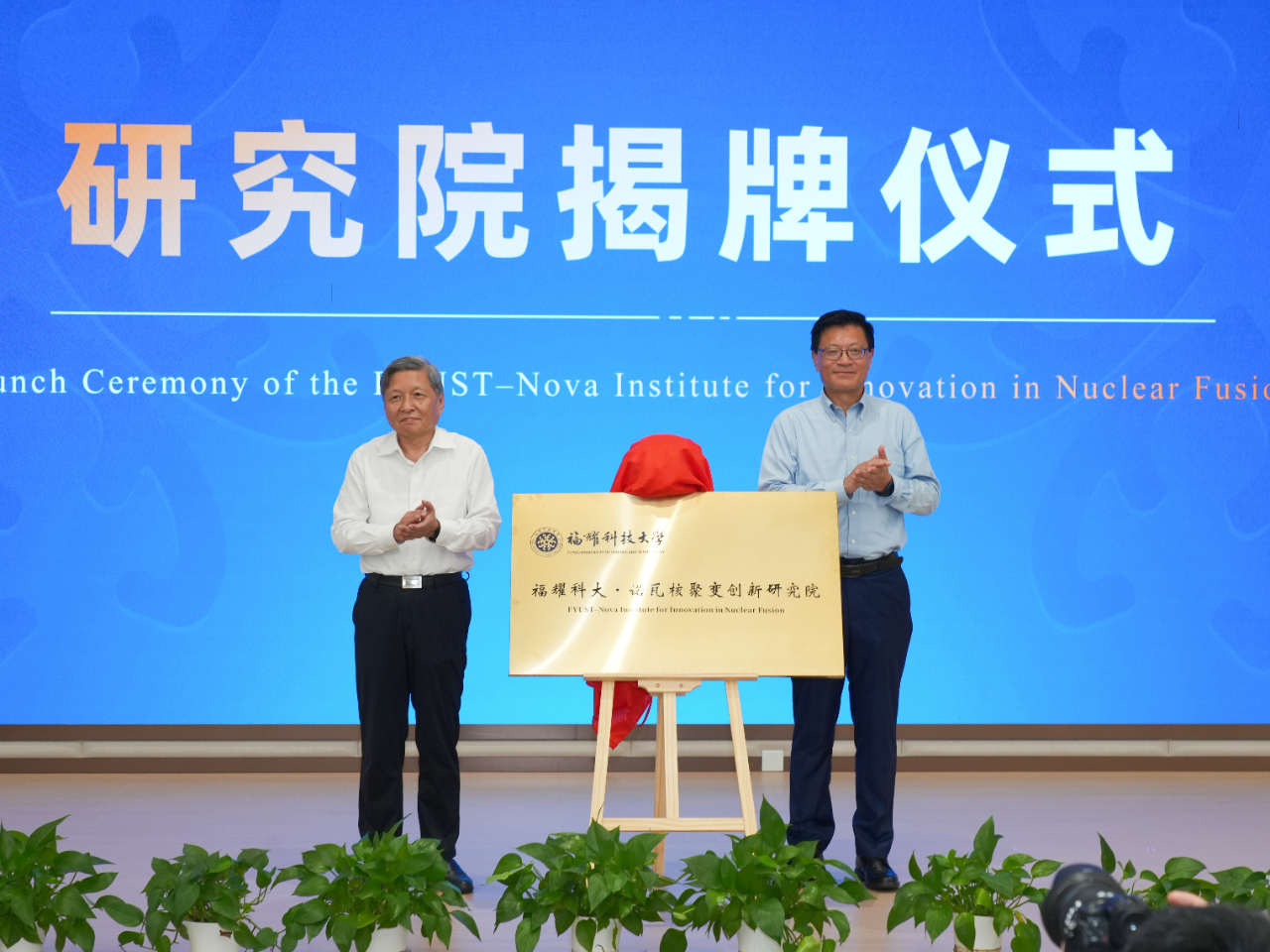
Nova Fusion and Fuyao University of Science and Technology Jointly Established Fusion Innovation Research Institute and Innovation Laboratory Unveiled
On September 22, 2026, the Fuyao UST·Nova Fusion Innovation Research Institute and the Fuyao University of Science and Technology·Nova Fusion Innovation Laboratory were officially unveiled and established. Wang Shuguo, President of Fujian Fuyao University of Science and Technology, Guo Houyang, founder of Nova Fusion Energy Technology (Shanghai) Co., Ltd. (hereinafter referred to as "Nova Fusion"), and personnel from relevant departments including the Fujian Provincial Development and Reform Commission, Department of Education, Department of Science and Technology, and Department of Industry and Information Technology attended the unveiling ceremony. Zhang Fuli, Executive Vice President of Fuyao University of Science and Technology, presided over the ceremony. The Fuyao UST·Nova Fusion Innovation Research Institute and the Fuyao University of Science and Technology·Nova Fusion Innovation Laboratory established this time are jointly built by Fuyao UST and Nova Fusion, dedicated to promoting fusion energy technology from the laboratory to commercial application.
2026-09-23

New Progress in Research on Microstructural Stability of High-Silicon Austenitic Steels for Lead-Cooled Fast Reactors
The lead-cooled fast reactor is an important reactor type in the fourth-generation nuclear energy system, and its structural materials need to withstand harsh service environments such as high temperature, irradiation, and liquid lead-bismuth corrosion over the long term. High-silicon austenitic stainless steel possesses excellent lead-bismuth corrosion resistance and is an important candidate structural material for core equipment such as the reactor vessel and internals of lead-cooled fast reactors. However, Si addition significantly alters the phase precipitation mechanism during high-temperature service and induces austenite decomposition, affecting the long-term microstructural stability of the material. Recently, the Special Alloys Research Department of the Institute of Metal Research, Chinese Academy of Sciences, in collaboration with the Department of Mechanical Engineering of The Hong Kong Polytechnic University, building on prior work that revealed Si-induced austenite decomposition behavior in high-silicon austenitic steels and the resulting mechanical...
2026-09-21