
Search Results
Keyword:nuclear fusion

France's ITER research program may start before 2034
Scientific preparation work for the International Thermonuclear Experimental Reactor (ITER) is currently about 7 months ahead of the original schedule, and the research program may start earlier than the previously set target of 2034. Anatoly Krasilnikov, Director of the ITER Project Center at Rosatom, revealed this progress during the Technoprom-2026 forum. Krasilnikov stated that the project team no longer uses the milestone term "first plasma," but has instead adjusted the objective to "start of the research program," with a target date of 2034. Based on the current progress, the work is 7 months ahead of schedule, and there is a possibility of achieving the goal ahead of time...
2026-08-28

Japan to Build Fusion Tritium Fuel Research Base in Aomori Prefecture
Japan's Ministry of Education, Culture, Sports, Science and Technology (MEXT) has decided to establish a new fusion power generation research base in Aomori Prefecture, focusing on tritium fuel handling technology. The base will target the development needs of fusion demonstration projects in the 2030s, promoting joint research and development among industry, government, and academia. MEXT plans to include approximately 100 billion yen in fusion development-related funding in its budget request for the next fiscal year. Fusion power generation releases energy through the fusion reaction of deuterium and tritium nuclei, a principle similar to the energy generation process inside the sun. Unlike traditional nuclear power that relies on nuclear fission chain reactions, fusion reactions carry a lower risk of runaway, leading many countries to view it as an important direction for future energy technology...
2026-08-28

U.S. Marathon Fusion Demonstrates Hydrogen and Lithium Isotope Enrichment Technology
U.S.-based Marathon Fusion announced on August 27 that it has successfully demonstrated hydrogen and lithium isotope enrichment technology using its proprietary plasma centrifuge. The company stated that this advancement addresses the fuel cycle needs of fusion energy and related isotope supply requirements. In the deuterium-tritium fusion pathway, hydrogen isotope processing is critical to the continuous operation of fusion devices, while lithium isotope enrichment is closely tied to tritium production. The U.S. Department of Energy (DOE) released its "Fusion Science and Technology Roadmap" in June of this year, which identifies tritium processing as one of the core challenges, noting that related progress is essential for achieving sustained deuterium-tritium fusion operation and validating fusion as a large-scale energy form...
2026-08-28

Japan's Helical Fusion and Tohoku University Launch Social Communication Research on Fusion Energy
Helical Fusion recently announced that it has launched a joint research project with the Takahashi-Kariwara Laboratory of the Graduate School of Engineering at Tohoku University in August 2026, focusing on ideal communication methods for the social implementation of fusion energy. The project is planned to last approximately one year, with a focus on exploring the communication methods, dialogue mechanisms, and decision-making pathways required for fusion energy to move toward social application. According to the project plan, both parties will examine cases of existing advanced technologies in areas such as social acceptance and risk perception to study communication strategies needed for the stable application of fusion energy in future society. The research also plans to introduce...
2026-08-27

South Korea's POSCO Group Invests in Japanese Fusion Company Kyoto Fusion Engineering
South Korea's POSCO Group has invested in Japanese fusion energy company Kyoto Fusion Engineering (KF) to establish an early presence in the global fusion energy market and explore new business opportunities in future steel, specialty materials, and energy infrastructure. According to industry sources on the 27th, POSCO Group participated in Kyoto Fusion Engineering's Series D funding round. The investment was made through the Korea-Japan Fusion Fund, established by IMM Investment Japan (IMMJ) together with Korean and Japanese investors. POSCO Holdings and POSCO International also contributed to the fund...
2026-08-27

NSF Funds $30 Million Turbulence Research Center Focused on Predictive Modeling for Fusion Energy
The U.S. National Science Foundation (NSF) has established a new Science and Technology Center with a total funding of $30 million, focusing on the understanding and prediction of turbulence. The project targets application scenarios such as fusion energy, astrophysics, and hypersonic flight, aiming to tackle the challenges of cross-scale turbulence modeling and prediction in complex physical systems. Researchers and students from San José State University (SJSU) will participate in the related research. This is a three-dimensional simulated turbulent velocity field at the core collapse point of a massive star before a supernova explosion. Image credit: S. Couch, based on research by Fields and Couch published in The Astrophysical Journal, Volume 921, Page 28.
2026-08-27

Iran Says Nuclear Fusion to Become Priority in Nuclear Industry Development
At a national Government Week celebration ceremony held in Tehran, Mohammad Eslami stated that developing nuclear fusion is a priority direction for the future of Iran's nuclear industry. Iran needs to rely on its domestic capabilities, knowledge-based enterprises, and universities to drive progress in related fields. Eslami said that the innovation network of the Atomic Energy Organization of Iran (AEOI) is providing support for nuclear fusion activities, shifting related work from the technology demonstration stage further toward system development and capacity building. He also stated that the establishment of the Non-Destructive Testing (NDT) training center is an initiative to enhance industrial quality, promote technological advancement, and cultivate domestic professional expertise...
2026-08-27
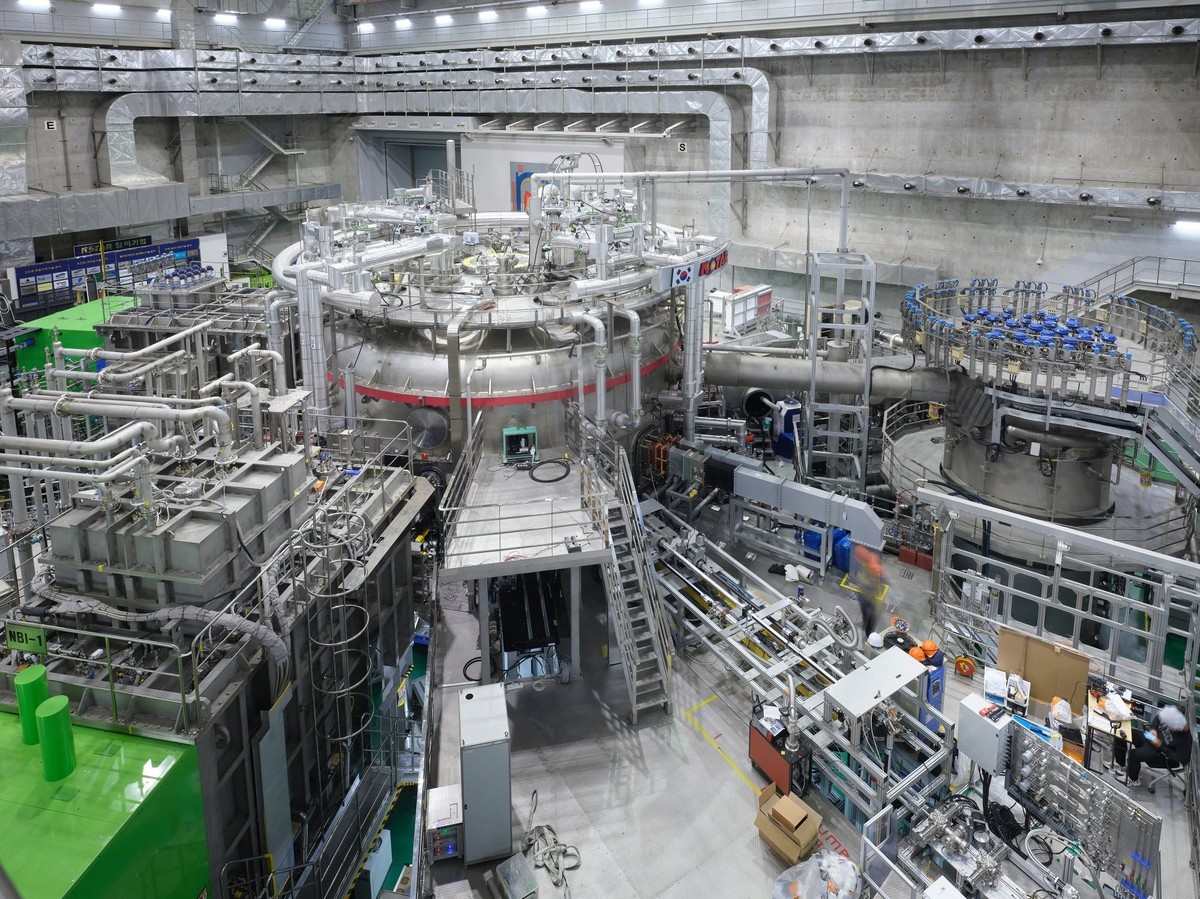
South Korea's KSTAR to Conduct Long-Pulse Fusion Research in Tungsten Environment with European Institutions
The Korea Institute of Fusion Energy (KFE) announced on August 27 that it has signed implementation agreements with multiple fusion research institutions in France, Italy, Germany, and Finland to conduct joint research on long-duration plasma operation in a tungsten environment using the Korea Superconducting Tokamak Advanced Research (KSTAR) device. Partner institutions include the French Alternative Energies and Atomic Energy Commission (CEA), the Italian National Agency for New Technologies, Energy and Sustainable Economic Development (ENEA), the Max Planck Institute for Plasma Physics (IPP) in Germany, and the VTT Technical Research Centre of Finland (VTT). The institutions will focus on key technologies required for long-pulse operation of future fusion reactors...
2026-08-27

AMPERA and Lawrence Livermore National Laboratory Collaborate to Develop Advanced Nuclear Fuel
AMPERA announced on August 26 that it has established a strategic partnership with Lawrence Livermore National Laboratory (LLNL), which operates under the U.S. Department of Energy (DOE) National Nuclear Security Administration (NNSA) system. The two parties will collaborate on next-generation advanced nuclear fuels, with a focus on applications such as compact nuclear energy systems and subcritical reactor platforms. Under the collaboration arrangement, the two parties will jointly advance the development of manufacturing processes related to tristructural isotropic (TRISO) fuel. Project objectives include improving the reliability, licensability, and scalability of fuel manufacturing,...
2026-08-27

MIIT: Promote Future Industries Including Nuclear Fusion Energy as New Growth Drivers
The State Council Information Office held a press conference on August 26, where the Ministry of Industry and Information Technology (MIIT) briefed on efforts to fully implement the 15th Five-Year Plan and accelerate new industrialization. The MIIT stated that over the next five years, it will focus on optimizing the industrial structure, coordinating the transformation and upgrading of traditional industries, nurturing and strengthening emerging industries, and making forward-looking arrangements for future industries, while maintaining and developing a complete industrial system. In terms of future industry layout, the MIIT proposed promoting quantum technology, biomanufacturing, hydrogen energy and nuclear fusion energy, brain-computer interfaces, embodied intelligence, and sixth-generation mobile communications as new economic growth drivers. The inclusion of nuclear fusion energy in future industry directions reflects its important position in new industrialization and the cultivation of strategic emerging industries.
2026-08-27

Target Image of "Artificial Sun" China Huanliu-4 Released
The 2026 Fusion Energy Conference and Fusion Energy Week opened in Shanghai on the 25th. The target image of the "Artificial Sun" China Huanliu-4 was released at the opening ceremony. China Huanliu-4 is a fourth-generation magnetic confinement fusion large-scale scientific experimental device and the world's first high-temperature superconducting strong-field steady-state burning experimental platform. It will systematically verify the reliability of high-temperature superconducting strong-field magnets in complex fusion environments, demonstrate full-domain intelligent control of fusion reactors, and achieve long-duration steady-state operation of the device. Fusion energy is an important direction for the future development of human energy, and major countries around the world are competing to position themselves in the new track of fusion energy. Zhang Guangjun, Vice Minister of Science and Technology, pointed out on the same day that the 15th Five-Year Plan will incorporate controlled nuclear fusion as a future energy technology into key directions for energy innovation development, and list controlled nuclear fusion as a major national frontier science and technology project.
2026-08-26

Japan's JT-60SA Experimental Team Advances Preparations for Next Operation Phase
Preparations for the next phase of JT-60SA experimental activities are underway. The technical team is carrying out integrated commissioning as planned, while the experimental team is simultaneously refining related tools and software to enhance scientific output capabilities for the next operation phase. During a training course organized by QST, EUROfusion participants are learning how to configure discharge settings using the Human-Machine Interface (HMI) in preparation for the next JT-60SA campaign. Image credit: QST. The Third JT-60SA Experimental Team Workshop was held from July 27 to 31, 2026, at the Naka Institute of the National Institutes for Quantum Science and Technology (QST) in Japan. Approximately 50 experts attended, including 20 representatives from Europe...
2026-08-26

U.S. Research Reveals Diamond Melting Mechanism at High Pressure, Potentially Enhancing Inertial Confinement Fusion Performance
A research team at Lawrence Livermore National Laboratory (LLNL) in the U.S. recently published a study in Nature Physics reporting that the latest dynamic compression experiments have, for the first time, directly recorded atomic structural changes during diamond melting under extreme high pressure. The experiments showed that under high-pressure conditions, solid diamond can float in liquid metallic carbon, similar to ice floating on water. Diamond is not only a high-hardness carbon material but is also used as the fuel target capsule shell in inertial confinement fusion experiments. When intense lasers drive the capsule implosion, the compression and melting behavior of the diamond shell can affect whether the fusion fuel reaches the required high-temperature, high-pressure state. Meanwhile, the planetary science community has long focused on the high-pressure behavior of carbon in the deep interiors of ice giant planets...
2026-08-26

Japan's Helical Fusion Publishes Research Results on High-Temperature Superconducting Magnets
Helical Fusion recently announced that its joint research on high-temperature superconducting magnets with the National Institute for Fusion Science (NIFS) has passed peer review and been published in the Journal of Physics: Conference Series. The results, previously disclosed in a preliminary report, primarily validate the performance of high-temperature superconducting conductors for fusion reactor applications under strong magnetic fields and high currents. This study tested the UROCOIC high-temperature superconducting conductor independently developed by Helical Fusion. The research team fabricated the conductor into a double-pancake coil sample and used existing test equipment to simulate, as closely as possible, the magnetic field and current environment expected in future fusion reactors.
2026-08-26

South Korea launches next-generation nuclear energy research talent training program
South Korea's talent training program for postdoctoral researchers in the nuclear energy field has officially been launched, which will be based on university laboratories to promote future nuclear technology research, industry-academia-research cooperation, and employment linkage. On August 25, during the 2026 Climate and Energy Job Fair, the Ministry of Climate, Energy and Environment, the Korea Institute of Energy Technology Evaluation and Planning (KETEP), and the Korea Radiation Promotion Association held the next-generation energy leader training program in the nuclear energy field...
2026-08-26